
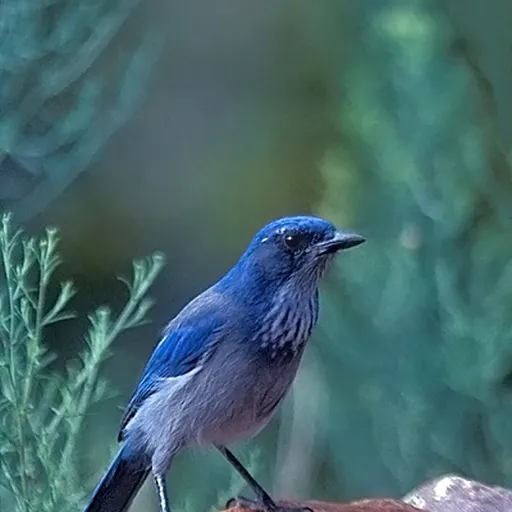
Woodhouse's Scrub Jay
Aphelocoma woodhouseii
Overview
Woodhouse's scrub jay (Aphelocoma woodhouseii) is a non-migratory species of scrub jay native to western North America, ranging from southeastern Oregon and southern Idaho to central Mexico. It is distinct from the California scrub jay but was historically grouped with it as the western scrub jay. This adaptable bird can even become tame in urban environments, frequently visiting bird feeders.
Identification
- Size: Medium-sized, approximately 27–31 cm (11–12 in) in length with a 39 cm (15 in) wingspan.
- Plumage: Features a blue head, wings, and tail; a gray-brown back; and grayish underparts with a whitish throat and a partial blue breast band ("necklace").
- Bill: Heavy but straight, hardly hooked at the tip, with a longer and more pointed shape in the Nevada subspecies.
- Vocalisation: The call is described as harsh and scratchy.
Habitat
This species inhabits areas of low scrub, favouring pinon-juniper forests, oak woods, and the edges of mixed evergreen forests, while also appearing in scrub-brush, boreal forests, and temperate forests. It is very common west of the southern Rocky Mountains, where it thrives in diverse landscapes from desert to woodland.
Diet
Woodhouse's scrub jays forage in pairs, family groups, or small non-kin groups, feeding on small animals such as frogs, lizards, eggs, insects, grains, nuts, and berries. They are aggressive towards other birds and are known to steal hoarded acorns from acorn woodpecker granary trees and rob seeds from Clark's nutcrackers.
Did you know?
These intelligent birds, whose brain-to-body mass ratio rivals that of chimpanzees, are the only non-primate and non-dolphin shown to plan ahead for the future. They can remember the locations of over 200 food caches, including the specific food item in each and its rate of decay, often choosing cache sites out of sight of competitors.