
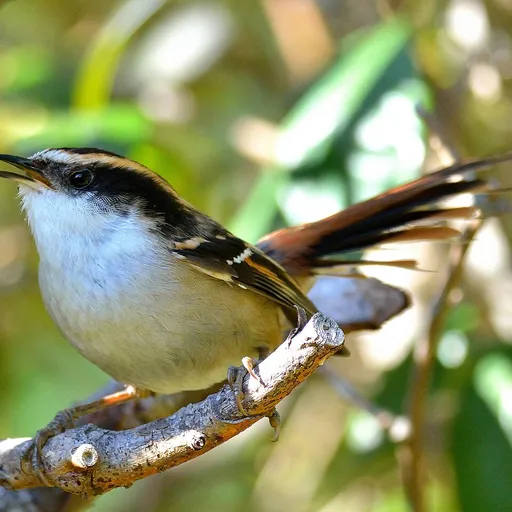
Thorn-tailed Rayadito
Aphrastura spinicauda
Least Concern
Overview
The thorn-tailed rayadito (Aphrastura spinicauda) is a species of bird in the family Furnariidae that remains the most common and best-known native bird in temperate forests of southern Chile and Argentina. It is found in temperate forests and subtropical dry shrubland south of 30°S, often occurring at densities of well over one individual per hectare. Although currently listed as Least Concern, some sources suggest it may formerly have occurred in the Falkland Islands.
Identification
- Approximately 14 cm in length and weighing around 11 g, with males roughly 10% heavier than females.
- Plumage is generally brown with black lines on the upperparts and white below, though the throat may be cinnamon on Chiloé Island and dorsal black lines may be absent on Mocha Island.
- Possesses a distinctive long "thorn"-tail with twelve spiny rectrices that develops gradually in juveniles and is used for courtship rather than climbing.
- Voices include a loud trill, a scolding alarm call described as "tsii...tsii...tsii", and a softer repetitive "trrrrrreet" trill used outside the breeding season.
Habitat
The species inhabits temperate forests and subtropical dry shrubland south of 30°S, ranging from central Chile and adjacent Argentina south to Tierra del Fuego. It adapts to various forest types, including tall Nothofagus and Araucaria forests in the north, low subantarctic forests in the far south, and relatively dry Austrocedrus forests in the east, though it does not extend into the "scrub beech" east of the cedar forest. Mocha Island was identified as a prominent glacial refuge for the species during the Patagonian Ice Age.
Diet
Exclusively insectivorous, the thorn-tailed rayadito forages by searching bark and moss surfaces for small insects, similar to tits in the northern hemisphere. It typically forages in noisy flocks during the non-breeding season, often outnumbering other Furnariidae species such as white-throated treerunners and striped woodpeckers, but becomes strongly pair-territorial during the breeding season.
Did you know?
Rayadito eggs are exceptionally large, approximately fifty percent larger than expected for an 11-gram passerine, which necessitates that females lay them only every other day. These birds are also highly curious and fearless, exhibiting inquisitive behaviour in the presence of humans within their forest habitats.
Sources
- Wikipedia · CC BY-SA 4.0
- Wikidata · CC0 1.0