
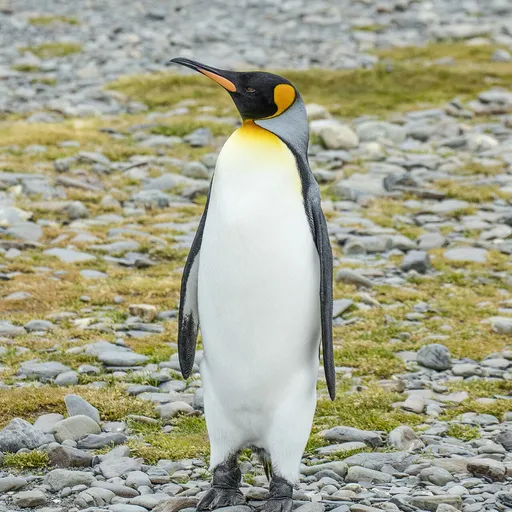
King Penguin
Aptenodytes patagonicus
Least Concern
Listen
XC879318 · steve · Stromness, Antarctica · CC BY-SA 4.0
Overview
The king penguin, Aptenodytes patagonicus, is the second largest species of penguin, closely resembling but smaller than the emperor penguin. Currently classified as Least Concern, it is a flightless seabird that forms massive breeding colonies on subantarctic islands.
Identification
- Stands 70 to 100 cm tall with a sleeker body and larger flippers than the emperor penguin, featuring a grizzled sooty-greyish back rather than blackish feathers.
- Distinctive solid bright orange cheek patches and upper chest plumage, contrasting with the emperor penguin's yellow and white markings.
- Possesses a longer, straighter bill than the emperor penguin, with orange markings on the lower mandible compared to the emperor's pinkish tones.
- Chicks are easily distinguished by their heavy dark brown down and long bills, unlike the grey chicks of the emperor penguin.
Habitat
King penguins breed on subantarctic islands between 45 and 55°S latitude, including the northern reaches of Antarctica, South Georgia, and the Falkland Islands. They also inhabit temperate islands such as Macquarie Island and the Kerguelen Islands, often forming large circumpolar colonies that are occupied year-round.
Diet
Diet consists primarily of lanternfish, squid, and krill, with fish making up roughly 80% of their intake outside of winter. They forage by diving during daylight to depths of 100–300 metres, using flat-bottomed dives to hover and hunt before returning to the surface.
Did you know?
King penguins adhere to a strict diet and rarely vary their prey, sometimes staying at sea for extended periods to compensate for lower foraging success due to the southward movement of food sources caused by climate change.
Sources
- Wikipedia · CC BY-SA 4.0
- Wikidata · CC0 1.0