
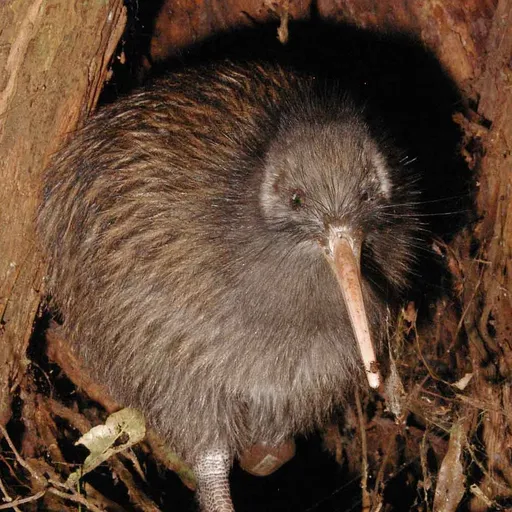
North Island Brown Kiwi
Apteryx mantelli
Vulnerable
Overview
The North Island brown kiwi (Apteryx mantelli) is a nocturnal, flightless bird and the most common of the kiwi species, with approximately 35,000 remaining. It is widespread across the northern two-thirds of the North Island of New Zealand. The species is classified as Vulnerable on the IUCN Red List, primarily due to threats from mammalian predators such as dogs, cats, and stoats.
Identification
- Possesses spiky, streaked brown feathers and a long, slightly down-curved bill measuring 13–20.5 cm in length.
- Exhibits size-based sexual dimorphism, with females being observably larger than males, weighing between 2.06–3.85 kg, while males weigh 1.44–3.06 kg.
- Produces a distinctive "whistle call" performed solo or in duets; males emit high-pitched, multi-harmonic notes, whereas females produce low-frequency notes.
Habitat
North Island brown kiwi inhabit four primary regions in New Zealand's North Island: Northland and its associated islands, the Coromandel, eastern North Island, and western North Island. They generally prefer densely vegetated lowland and coastal indigenous forest, though they can also thrive in exotic pine forests, overgrown pasture, and sand dunes. Historically, their habitat was the indigenous forest that covered terrestrial land prior to human colonisation.
Diet
The diet consists primarily of invertebrates, including spiders and worms, which make up 85–95% of their intake, with the remainder being plant material. Foraging is predominantly nocturnal and relies on remote touch and smell rather than sight, using mechanoreceptors in the bill tip to detect vibrations from soil-dwelling prey. The most common foraging behaviour involves tapping and probing the ground substrate with their beaks.
Did you know?
The eggs laid by the North Island brown kiwi are among the largest in the world relative to the bird's body size, weighing 430 g and measuring 12.5 cm by 7.8 cm. Males develop a brood patch on their lower abdomen where feathers are shed to facilitate direct heat transfer for incubating these large eggs.
Sources
- Wikipedia · CC BY-SA 4.0
- Wikidata · CC0 1.0