
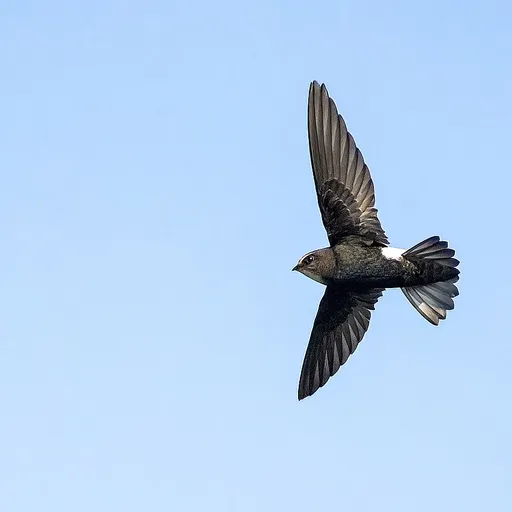
House Swift
Apus nipalensis
Least Concern
Overview
The house swift (Apus nipalensis) is a small, aerial bird belonging to the family Apodidae. It is characterised by its ability to fly long distances by alternately shutting off hemispheres of its brain while in flight. This species is generally found across the Asian continent and is currently classified as Least Concern on the IUCN Red List.
Identification
- Body length ranges from 14 to 16 cm with a wingspan of 12.5-14.5 cm, and it weighs approximately 20-35 g.
- The plumage is predominantly black, darker than the little swift, featuring a white rump band and a white throat-patch.
- It possesses a dark, slightly forked tail.
- Vocalisations include a specific "ti-ti-ti-tititrrrrrr" sound among other catalogues.
Habitat
House swifts inhabit both urban and rural areas across Asia, ranging from the mountainous regions of Nepal to cities and towns in China, Vietnam, and Hong Kong. Subspecies distributions vary, with some found in Japan, the Malay Peninsula, Java, Bali, and Taiwan. They are highly aerial and tend to nest in cliffs or under roof overhangs in urban settings.
Diet
House swifts forage in the air, feeding primarily on small organisms dispersed throughout the atmosphere. A faecal analysis indicates their diet consists almost solely of arthropoda, including ants, spiders, mosquitoes, and flies.
Did you know?
The house swift can sustain long-distance flight by alternately shutting off hemispheres of its brain. It has been recorded in North America only once in 2012, though this observation was unaccepted because the bird was found dead and identified via DNA sequencing.
Sources
- Wikipedia · CC BY-SA 4.0
- Wikidata · CC0 1.0