
Pacific Swift
Apus pacificus
Least Concern
Overview
The Pacific swift (Apus pacificus) is a species of bird in the family Apodidae, native to eastern Asia. It is strongly migratory, wintering in Southeast Asia and Australia. Classified as Least Concern by the IUCN, this species possesses a very large range and faces few significant threats.
Identification
- Length of 17–18 cm with a 43-to-54-cm wingspan; the largest of the Apus swifts.
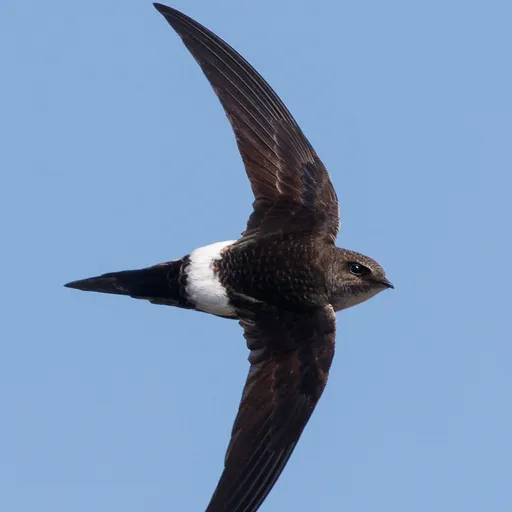
- Black upperparts with a distinct white rump band and a somewhat greyer head; underparts appear scaly due to white fringes.
- Deeper tail fork and longer wings compared to the common swift, with a more protruding head.
- Voice includes a trilled tsiririri or harsher spee-eer, described as softer and less wheezy than the common swift.
Habitat
A mainly aerial species, the Pacific swift is not limited to particular land habitats or climatic zones, breeding from the Arctic to sub-tropical China and up to 3,000 m in elevation. It often nests in sheltered locations such as caves, rock crevices, or under the eaves of houses, and is frequently found near human habitation.
Diet
Feeds exclusively on insects caught in flight, including bees, wasps, termites, moths, and flies. It typically hunts at heights up to 300 m, often near low-pressure areas, and forages in flocks that can reach tens of thousands in Australia.
Did you know?
The Pacific swift likely sleeps in flight when not nesting, a behaviour also seen in the common swift, and has occasionally been observed roosting in a tree or landing briefly on the ground.
Sources
- Wikipedia · CC BY-SA 4.0
- Wikidata · CC0 1.0