
Pallid Swift
Apus pallidus
Least Concern
Listen
XC1175993 · Sonothèque ADVL · Cabane Vauban (near Carolles), Manche, Normandie, France · CC0 1.0
Overview
The pallid swift (Apus pallidus) is a small passerine bird belonging to the swift family, characterised by its aerial lifestyle where it spends most of its life in the air. It is classified as Least Concern by the IUCN Red List.
Identification
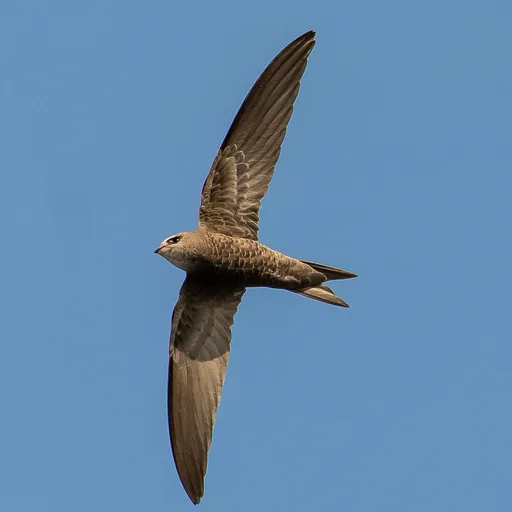
- Length of 16–17 cm with very long, swept-back wings resembling a crescent or boomerang and a short forked tail.
- Entirely dark plumage, notably browner and chunkier than the common swift, featuring a large, frequently visible white throat patch.
- Slightly paler flight feathers, underparts, and rump that provide more contrast than in the common swift, along with a scalier-looking belly.
- A loud, dry scream similar to the common swift, though possibly more disyllabic.
Habitat
Breeds on cliffs and eaves around the Mediterranean, the Canary Islands, and Madeira. It is rare but likely under-recorded north of its breeding range due to identification difficulties. Migratory species that winters in southern Africa or southeast Asia.
Diet
Lives on insects caught in the beak while in flight. It drinks on the wing and never settles voluntarily on the ground.
Did you know?
GPS tracking of pallid swifts breeding in Gibraltar revealed that two individuals showed no indication of coming to land during their winter season, supporting the finding of an airborne existence outside the breeding season. One bird also demonstrated remarkable fidelity to specific wintering grounds in Africa across two consecutive years.
Sources
- Wikipedia · CC BY-SA 4.0
- Wikidata · CC0 1.0