
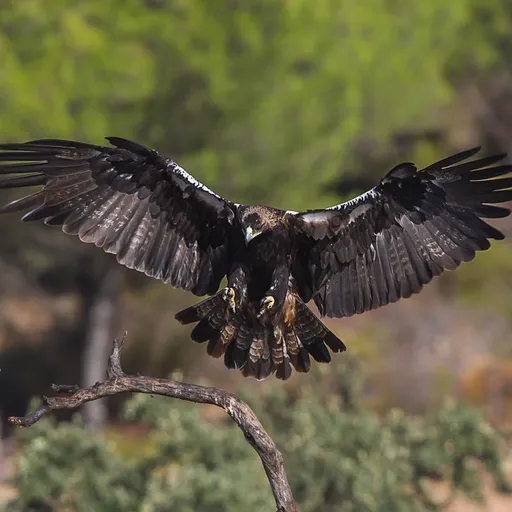
Spanish Imperial Eagle
Aquila adalberti
Vulnerable
Overview
The Spanish imperial eagle (Aquila adalberti) is a large raptor native to the Iberian Peninsula that is classified as Vulnerable on the IUCN Red List. Although formerly considered a subspecies of the eastern imperial eagle, it is now widely recognised as a distinct species based on morphological, ecological, and molecular differences. The binomial name commemorates Prince Adalbert of Bavaria, and the bird was historically known as the white-shouldered eagle due to its distinctive plumage.
Identification
- Adults exhibit rich blackish-brown plumage extending from the throat to the belly, contrasting with a much paler tawny nape and crown.
- A broad, distinctive white band runs across the shoulder and leading edge of the wing, appearing more pronounced than in the eastern imperial eagle.
- Juveniles are uniform pale straw-sandy with broad black bands on the wings, featuring a relatively longer neck and a much flatter wing profile in flight than the golden eagle.
- The species is a large eagle weighing between 2.5 and 4.8 kg, with a total length of 72 to 85 cm and a wingspan of 177 to 220 cm.
Habitat
This resident species occurs in central and south-west Spain and adjacent areas of Portugal, with its stronghold in the dehesa woodlands of Extremadura, Ciudad Real, and areas in the north of Huelva and Seville's Sierra Norte. Nesting habitat typically consists of dry, mature woodlands such as mature cork oaks or pine trees, often located near shrubby openings and wetland areas to facilitate hunting.
Diet
The eagle feeds mainly on European rabbits, which previously comprised about 58% of its diet, but has adapted to a wider range of vertebrates following rabbit population crashes. Prey includes water birds such as Eurasian coots, ducks, and geese, as well as partridges, pigeons, crows, rodents, hares, and occasionally red foxes. It is an apex predator that often quarrels with other raptors and vultures over food, occasionally killing them in conflicts.
Did you know?
The species nearly reached extinction in the 1960s, with only 30 breeding pairs remaining, but recovery efforts have seen the global population grow to 324 pairs by 2011. In a notable instance of interspecies conflict, an adult Spanish imperial eagle was recorded killing a cinereous vulture, the largest accipitrid in the world, while protecting its own nest.
Sources
- Wikipedia · CC BY-SA 4.0
- Wikidata · CC0 1.0