
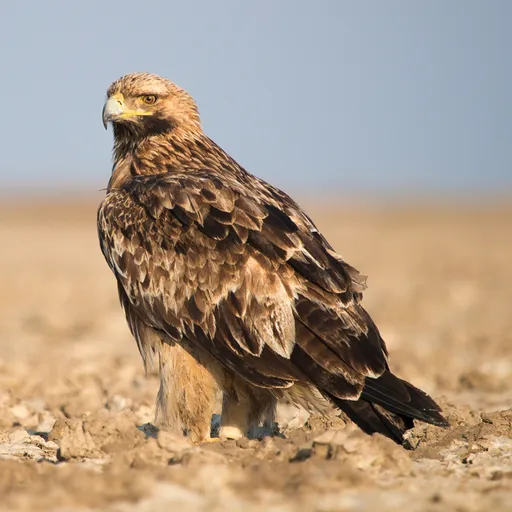
Eastern Imperial Eagle
Aquila heliaca
Vulnerable
Overview
The eastern imperial eagle (Aquila heliaca) is a large, dark-coloured bird of prey that is usually the darkest eagle species in its range. It breeds in southeastern Europe and across West and Central Asia, with most populations migrating to northern Africa, the Middle East, and South and East Asia for the winter. Classified as Vulnerable on the IUCN Red List, the global population is small and declining due to persecution, habitat loss, and prey depletion.
Identification
- Adults are largely tar-like blackish-brown with a highly contrasting creamy to golden buff crown, hindneck, and neck sides, plus bold white epaulettes on the shoulders.
- Juveniles are pale tawny-buff to sandy yellow with heavy dark brown streaking from the throat to the breast, and white-tipped flight feathers forming wing bars.
- Possesses a relatively long and thick neck, a large head and bill, and long, well-feathered legs, giving it a projecting profile in flight.
- Emits a deep, harsh bark ('owk owk' or 'kraw-kraw') repeated rapidly up to 8–10 times, which is perceptibly deeper and harsher than the call of the golden eagle.
Habitat
The species strongly prefers the interface between tall woods and plains or other open, relatively flat habitats, including the wooded mosaics of the steppe. Nests are typically located in large, mature trees, where parents raise one or two fledglings. Its breeding range covers southeastern Europe and West and Central Asia, while it winters in northeastern Africa, the Middle East, and South and East Asia.
Diet
This opportunistic predator mostly selects small mammals as prey but also consumes a significant proportion of birds, reptiles, and other prey types, including carrion. No specific foraging techniques or hunting behaviours are described in the reference material.
Did you know?
The eastern imperial eagle is relatively less shy and bolder in the presence of humans compared to other Aquila eagles. It also displays reverse sexual dimorphism, with females being up to 10% larger in linear measurements and 40% heavier in body mass than males.
Sources
- Wikipedia · CC BY-SA 4.0
- Wikidata · CC0 1.0