
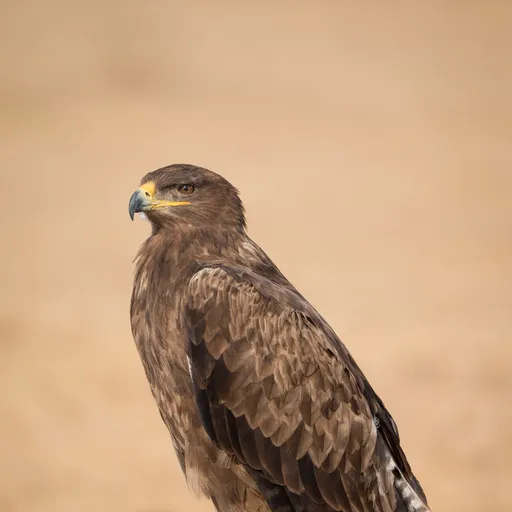
Steppe Eagle
Aquila nipalensis
Endangered
Overview
The steppe eagle (Aquila nipalensis) is a large, bulky bird of prey that is classified as endangered. It is a specialized predator that undergoes massive migrations and is the only eagle species that primarily nests on the ground. This species serves as the national bird of both Kazakhstan and Egypt.
Identification
- Adults are mainly dark brown with a long, thick neck and a small head featuring a strong bill and a very long gape-line.
- Adults possess prominent pale rufous to yellow-brown patches on the nape, while juveniles are paler with broad white tips on the blackish greater coverts and a bold cream band on the wings.
- The species has markedly well-feathered, dishevelled-looking legs and yellow cere and feet at all ages.
- In flight, the wings appear square-ended with seven elongated emarginations, and the broad body looks suspended beneath the wings.
Habitat
The steppe eagle inhabits treeless areas of steppe habitats, often nesting on slight rises or outcrops. It migrates in massive flocks across major flyways in the Middle East, Red Sea, and the Himalayas.
Diet
On breeding grounds, this species is a specialized predator of ground squirrels, also taking other small mammals. In winter, it exhibits a sluggish feeding ecology, focusing on insect swarms, landfills, carrion, and the semi-altricial young of assorted animals.
Did you know?
The steppe eagle is the only eagle that nests primarily on the ground, often building flat nests on open terrain.
Sources
- Wikipedia · CC BY-SA 4.0
- Wikidata · CC0 1.0