
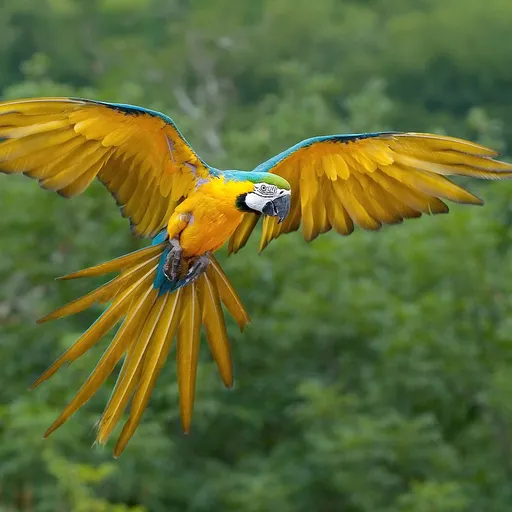
Blue-and-yellow Macaw
Ara ararauna
Least Concern
Overview
The blue-and-yellow macaw (Ara ararauna), also known as the blue-and-gold macaw, is a large Neotropical parrot characterised by its vibrant plumage. It is a member of the macaw group and is widely recognised as the most commonly kept large macaw species in captivity worldwide due to its striking colours and social nature.
Identification
- Reaches a length of 81–91 cm and weighs 1.0–1.5 kg, making it one of the larger members of its family.
- Features bright aqua blue feathers on the dorsum, a rich deep yellow or light orange venter, and lime-coloured head.
- Possesses a powerful black beak and black talons on grey feet.
- Has pale light yellow irises and white facial skin with few spaced black feathers forming a striped pattern around the eyes.
Habitat
Inhabits forest (especially varzea and unflooded terra firme), woodland, and savannah across tropical Central and South America, including the island of Trinidad. The range extends slightly into Central America but is restricted to Panama. While most populations breed in rural and forested areas, small numbers may nest in urban settings using dead ornamental palms.
Diet
Utilises its powerful beak to break nutshells and feed on seeds, fruits, vegetable matter, bark, and leaves. Insects and snails are reportedly consumed, though rarely. These birds forage by climbing up and hanging from trees to access food sources.
Did you know?
The blue-and-yellow macaw has been noted to blush its bare facial skin and fluff the feathers of its cheeks, head, and nape when interacting with humans, which may be an expression of its emotional state.
Sources
- Wikipedia · CC BY-SA 4.0
- Wikidata · CC0 1.0