
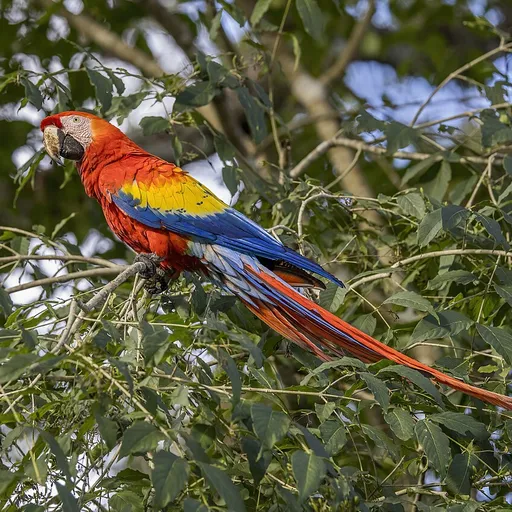
Scarlet Macaw
Ara macao
Least Concern
Listen
XC1005554 · Richard Borrmann · San Buenaventura (near Tumupasa), Iturralde, Departamento de La Paz, Bolivia · CC BY 4.0
Overview
The scarlet macaw, also known as the red-and-yellow macaw, is a large Neotropical parrot native to the humid evergreen forests of the Americas. As the national bird of Honduras, it is recognised by the IUCN as a species of Least Concern, though its habitat is increasingly fragmented.
Identification
- About 84 cm long with a pointed, graduated tail comprising more than half its body length; the larger Central American subspecies reaches up to 89 cm.
- Plumage is primarily scarlet with light blue rump and tail-coverts, yellow greater upper wing coverts, and dark blue upper flight feathers; wing undersides are dark red with metallic gold iridescence.
- Features a bare white facial patch with tiny white feathers, a pale horn upper mandible, a black lower mandible, and light yellow eyes in adults.
- Produces loud, high-pitched, throaty squawks, squeaks, and screams that can carry several kilometres.
Habitat
Prefers humid lowland subtropical rainforests, open woodlands, river edges, and savannas, typically found above the forest canopy more than 10 m above the ground. Its range extends from southeastern Mexico through Central America to Peru, Ecuador, Colombia, Bolivia, Venezuela, Honduras, and Brazil, including the Caribbean island of Trinidad and the Pacific island of Coiba. The species often visits natural mineral deposits or clay licks to ingest nutrients such as sodium and calcium.
Diet
Feeds primarily on fruits, nuts, seeds, flowers, and nectar high in the canopy, while consumption of insects, larvae, and snails is rare. In Costa Rica, they have adapted to feed on introduced teak and almond beach trees, with some populations benefiting from local conservation planting efforts.
Did you know?
Although typically docile, scarlet macaws can become formidably aggressive during breeding periods, sometimes killing their own chicks due to competition for limited food and nesting resources. Conservationists in Costa Rica now monitor nests and hand-rear vulnerable chicks to improve survival rates in regions where the birds were once nearly extinct.
Sources
- Wikipedia · CC BY-SA 4.0
- Wikidata · CC0 1.0