
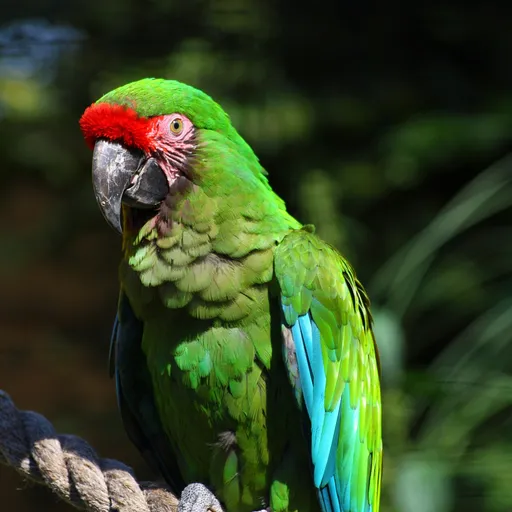
Military Macaw
Ara militaris
Vulnerable
Listen
XC1142075 · Rosa Elena Albornoz @rosaelena_naturaleza · Sarare (near Gamelotal), Simón Planas, Lara, Venezuela · CC0 1.0
Overview
The military macaw (Ara militaris) is a medium to large-sized macaw named after its green and red plumage, which vaguely resembles a military uniform. It is native to a range from west-central Mexico south through northern Argentina and Bolivia. Most wild populations are currently listed as vulnerable by the IUCN, though the species is commonly seen in zoos and parks worldwide.
Identification
- Measures 70 to 85 cm in length with a wingspan of 99–110 cm, distinguishing it from the similar great green macaw by its smaller size and completely black bill.
- Mostly green-plumed with light-blue and yellow flight and tail feathers, and a bright-red patch on the forehead.
- Features a bare, whitish face with black striations and a large, slate-grey, blackish bill with a yellow iris.
- Very noisy, producing loud cracking and shrieking sounds, including a distinct 'kraa-aak', that can be heard long before the bird is seen.
Habitat
Military macaws typically inhabit tropical deciduous and semi-deciduous forests, serving as canopy species that rely on large trees for feeding, breeding, and nesting. They generally reside at elevations of 600 to 1500 m, though they may seasonally fly down to lowlands with humid forests and thorny woodlands. Nesting occurs in natural cavities in trees at least 15 m tall or in cliff faces over 600 ft above the ground.
Diet
The diet consists mostly of seeds, but also includes fruits and leaves, with a somewhat narrow range of consumed plant species. Flocks leave their roosts at dawn to forage and frequently gather at 'macaw licks' on riverbanks to consume clay, which helps remove toxins from seeds and provides dietary salt. They have also been observed using Pseudalcantarea grandis for water and consuming latex from Plumeria rubra.
Did you know?
Military macaws are among the longest-lived companion animals, capable of living 50–60 years in the wild. They are crepuscular species, meaning their activity is most frequent in the morning and evening.
Sources
- Wikipedia · CC BY-SA 4.0
- Wikidata · CC0 1.0