
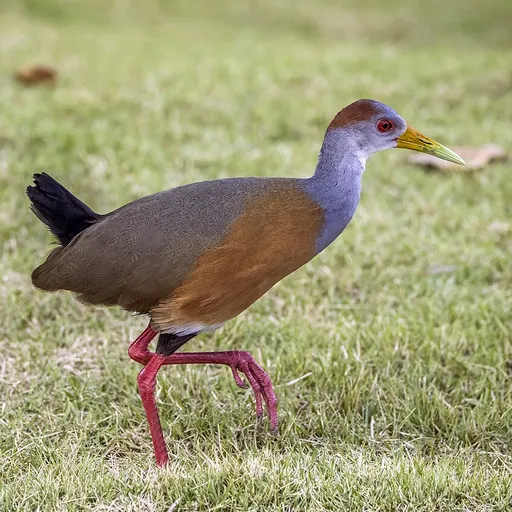
Russet-naped Wood Rail
Aramides albiventris
Least Concern
Overview
The russet-naped wood rail (Aramides albiventris) is a species of bird in the rail family, found from Mexico to Costa Rica. It was formerly considered a subspecies of the grey-cowled wood rail but was restored to full species status in 2016.
Identification
- Adults are 33 to 40 cm long and weigh about 450 to 600 g, with a thick dark yellow bill featuring a light green tip, deep red eyes, and red to pink legs.
- Plumage includes a slate gray forehead and crown with a chestnut patch on the back of the head, a grayish olive back, and black tail.
- The chin and upper throat are white, contrasting with a gray lower throat and upper breast, while the lower breast and belly are pale tawny cinnamon blending into a black lower belly.
- The song is described as a varied, rapid, crazed-sounding, rollicking, popping, and clucking series, often sounding like "pop-tiyi pop-tiyi co-co-co-co-co" or "kook-kook-kook-kway!-kway!-kway!-kway!".
Habitat
Found from Mexico to Costa Rica, the russet-naped wood rail inhabits a wide variety of wet and dry landscapes that provide dense cover. These include fresh and salt marshes, swamp forests, river and stream corridors, thorn forests, semi-evergreen forests, and mangrove forests.
Diet
The russet-naped wood rail forages mostly in dense vegetation, though it occasionally feeds in open areas such as stream banks and grassy patches near the forest. Its diet includes vegetable matter, snails, crabs, and even snakes.
Did you know?
The nest is a shallow bowl loosely constructed of sticks and plant fibres, placed a few metres up in a bush, vine, or tree, and is often situated above water.
Sources
- Wikipedia · CC BY-SA 4.0
- Wikidata · CC0 1.0