
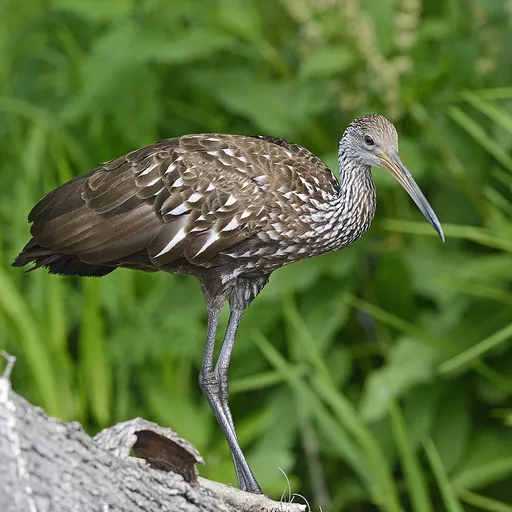
Limpkin
Aramus guarauna
Least Concern
Listen
XC675973 · Graznidos y gorjeos · Lagos De Regatas De Palermo (near Buenos Aires), Comuna 14, Buenos Aires, Argentina · CC0 1.0
Overview
The limpkin (Aramus guarauna) is a large wading bird related to rails and cranes, and the only extant species in the family Aramidae. It is found mostly in wetlands in warm parts of the Americas, from Florida to northern Argentina, though individuals have occasionally been reported as far north as Wisconsin and Southern Ontario.
Identification
- Moderately large bird, 64–73 cm long, with a wingspan of 101–107 cm.
- Plumage is drab dark brown with an olive lustre above, heavily marked with white on the head, neck, and back, giving a streaked appearance.
- Possesses a long, heavy, downcurved bill that is yellowish with a darker tip, often slightly curved to the right.
- Easier to hear than see, producing a loud, wild wail or scream with a rattling quality, such as "kwEEEeeer" or "klAAAar," especially at night and dawn/dusk.
Habitat
Inhabits freshwater marshes and swamps, often with tall reeds, as well as mangroves; in the Caribbean, it also occupies dry brushland. Its range extends from peninsular Florida and southern Mexico through the Caribbean and Central America to northern Argentina, occurring widely east of the Andes in South America. In Florida, the distribution of apple snails is the best predictor of where these birds can be found.
Diet
The diet is dominated by apple snails of the genus Pomacea, with freshwater mussels and other snails serving as secondary food sources. Limpkins forage in shallow water and on floating vegetation, walking slowly with an undulating gait to locate prey. They carry snails to land or shallow water to deftly remove the operculum and extract the animal, often leaving piles of empty shells at favoured spots.
Did you know?
The common names for this bird in various regions, such as 'carrao', 'courlan', and 'crying bird', are onomatopoeic and reflect its distinctive vocalisations. Its call has been used for jungle sound effects in Tarzan films and for the hippogriff in Harry Potter and the Prisoner of Azkaban.
Sources
- Wikipedia · CC BY-SA 4.0
- Wikidata · CC0 1.0