
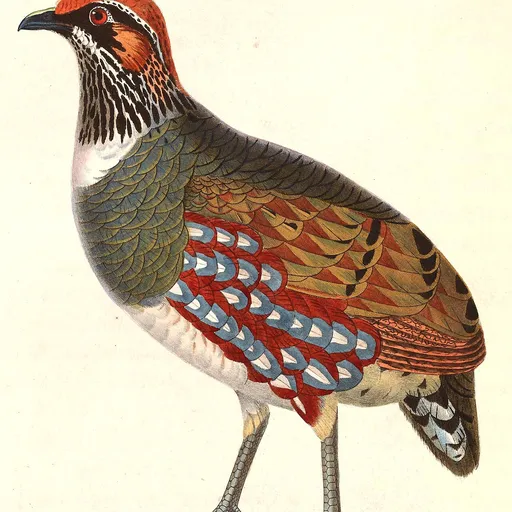
Hill Partridge
Arborophila torqueola
Least Concern
Overview
The common hill partridge, also known as the necklaced hill partridge, is a species of bird in the pheasant family native to Asia. It is currently classified as Least Concern on the IUCN Red List.
Identification
- Males feature an orange crown and face contrasting with a black head and streaked throat, while females lack these distinctive head markings.
- The species measures roughly 27–30 cm in length, with females weighing around 230 g and large males up to 390 g.
- Females possess grey chests and upper bellies, with white streaked ginger-brown flank feathers extending further up and across the belly compared to males.
- It emits a hen-like contact call that is constantly uttered when feeding.
Habitat
Found across a narrow band from the western Himalayas to north Vietnam, including India, Nepal, Bhutan, Tibet, Myanmar, Thailand, and Vietnam. It inhabits subtropical or tropical moist lowland and montane forests and is common throughout most of its range.
Diet
The bird consumes seeds and various invertebrates, which it gathers by scratching in leaf litter.
Did you know?
Indian populations breed between April and June, though earlier breeding has been recorded at lower altitudes.
Sources
- Wikipedia · CC BY-SA 4.0
- Wikidata · CC0 1.0