
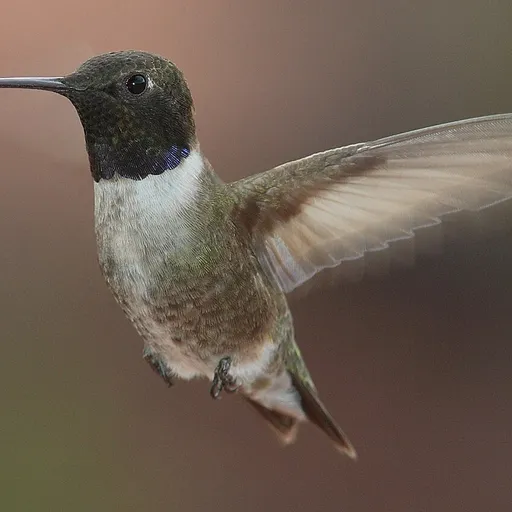
Black-chinned Hummingbird
Archilochus alexandri
Least Concern
Overview
The black-chinned hummingbird is a migratory hummingbird found across the western United States, southern British Columbia, and Mexico. It occupies a broad range of habitats, from deserts and mountain forests to urban areas, and is currently classified as a species of least concern by the IUCN.
Identification
- Size: Approximately 8.25 cm (3.25 in) long.
- Plumage: Adults are metallic green above and white-gray below with green flanks; males have a black face and chin with a glossy purple gorget visible in sunlight, while females lack a throat patch.
- Bill: Long, straight, and slender.
- Tail: Males have a dark forked tail; females have a dark rounded tail with white tips.
- Voice: Emits a rapid, high-pitched chirp.
Habitat
Found in the western United States, reaching north into British Columbia, east to Oklahoma, and south into Mexico. Breeding habitats consist of open, semiarid areas near water, but the species also inhabits mountains, woodlands, orchards, meadows, chaparral, and urban environments.
Diet
Feeds on nectar from flowers using a long, extendable tongue and catches insects on the wing. This feeding behaviour also assists in plant pollination.
Did you know?
Males perform a "pendulum" display involving wide U-shaped arcs and 40–60 ft (12–18 m) dives, producing an audible trill as air passes through their feathers during the plunge. Females may purposefully nest near the active nests of larger predatory birds to deter other avian predators from their eggs and chicks.
Sources
- Wikipedia · CC BY-SA 4.0
- Wikidata · CC0 1.0