
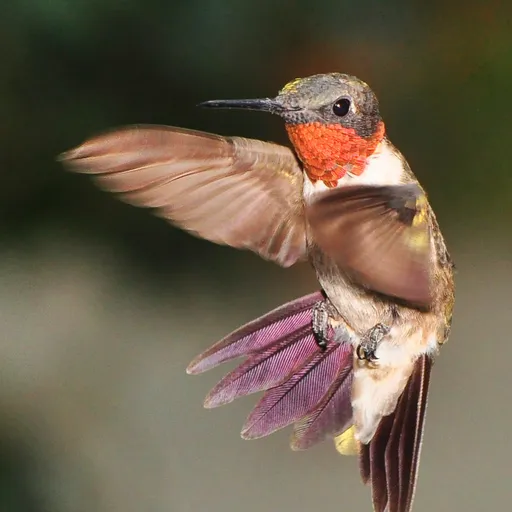
Ruby-throated Hummingbird
Archilochus colubris
Least Concern
Overview
The ruby-throated hummingbird (Archilochus colubris) is a migratory species that is the most common hummingbird in eastern North America. It winters in Central America, Mexico, and Florida, and migrates to Canada and the eastern United States to breed.
Identification
- Adults are metallic green above with greyish white underparts and near-black wings, measuring 7 to 9 cm in length.
- The species is sexually dimorphic: males possess a distinct iridescent ruby-red gorget bordered by black, while females have white throats that may be streaked with dusky markings.
- Vocalisations consist of rapid, squeaky chirps used primarily for territorial threats, accompanied by a rapid ticking wing sound during courtship displays.
Habitat
Breeding habitats include deciduous and pine forests, forest edges, orchards, and gardens throughout the eastern United States and southern Canada. The species winters in Florida, southern Mexico, Central America, and the West Indies, having the largest breeding range of any hummingbird in the United States.
Diet
The primary food sources are nectar from flowers and flowering trees, as well as small insects and spiders which provide essential protein. Birds forage using a long, extendable tongue to access nectar and catch insects on the wing, from foliage, or from spider webs, showing a slight preference for red, orange, and bright pink tubular flowers.
Did you know?
Ruby-throated hummingbirds are capable of a non-stop flight across the Gulf of Mexico lasting up to 20 hours, during which they expend their entire calorie reserve. To prepare for this migration, they can double their fat mass, and their heart rate can reach up to 1260 beats per minute.
Sources
- Wikipedia · CC BY-SA 4.0
- Wikidata · CC0 1.0