
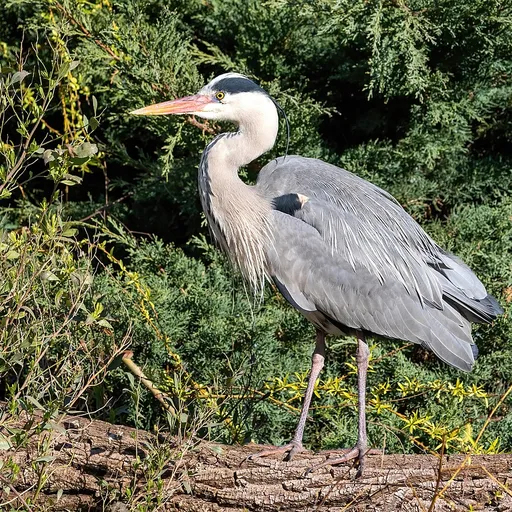
Grey Heron
Ardea cinerea
Least Concern
Listen
XC1178157 · Philippe Grange · ARS-EN-RÉ - Déviation (near Ars-en-Ré), Charente-Maritime, Nouvelle-Aquitaine, France · CC0 1.0
Overview
The grey heron (Ardea cinerea) is a long-legged wading bird native to temperate Europe, Asia, and parts of Africa. It is a resident species in much of its range, though populations from more northern regions migrate southwards in autumn.
Identification
- Standing up to 1 metre tall with a wingspan of 155–195 cm, adults have ashy-grey plumage above and greyish-white underparts.
- Features a white head and neck marked by a broad black stripe extending from the eye to a black crest, with yellow eyes and long, brown legs.
- The long, straight bill is pinkish-yellow and appears brighter in breeding adults.
- The main call is a loud croaking "fraaank", accompanied by various guttural noises in breeding colonies.
Habitat
Found throughout most of the Palearctic realm, the species occupies wetland areas including lakes, rivers, ponds, marshes, and sea coasts. It requires water bodies that are shallow enough or have shelving margins to allow wading, though it also forages in pastures and occasionally in desert areas.
Diet
The grey heron preys on fish, amphibians, crustaceans, insects, and small mammals by standing stationary in shallow water or stalking prey. It also employs a 'stress and wash' technique to flush toxins from newts, and may catch and kill juvenile birds such as ducklings.
Did you know?
In the Netherlands, grey herons have established themselves in urban environments like Amsterdam, where they visit street markets and snack bars to scavenge food. They have also been observed visiting zoo water enclosures to steal food intended for animals such as penguins and otters.
Sources
- Wikipedia · CC BY-SA 4.0
- Wikidata · CC0 1.0