
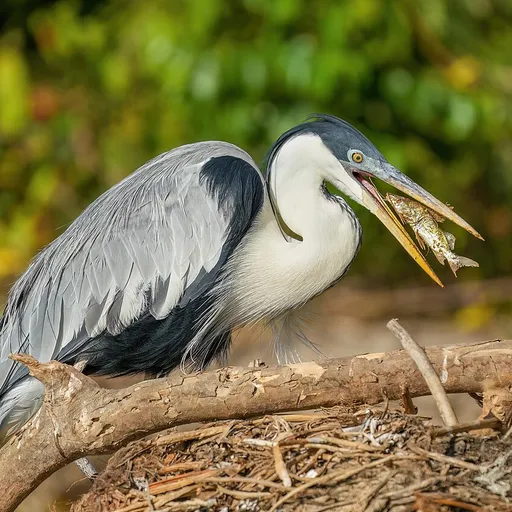
Cocoi Heron
Ardea cocoi
Least Concern
Overview
The cocoi heron (Ardea cocoi) is a large, long-legged wading bird in the family Ardeidae, native to South America and parts of Central America. As the largest heron species in South America, it is a carnivorous predator that primarily hunts in shallow water environments.
Identification
- Predominantly pale grey plumage with a white S-shaped neck, contrasting black crown and crest, and black streaking on the upper breast.
- Large size, measuring 95–130 cm in length, with a dull yellow bill and usually yellow iris.
- Distinctive deep croaking call.
- Similar to the grey heron but features slightly darker colouration and a longer neck and crest.
Habitat
Found throughout much of South America, excluding the Andes and parts of Argentina, with an estimated range extending from Central America to the Strait of Magellan. It inhabits almost any body of water or wetland away from dense forest, including lake shores, swamps, rivers, and estuaries, at elevations up to 2550 m above sea level.
Diet
This heron feeds primarily on fish over 20 cm long, alongside mammals, amphibians, and occasionally insects or carrion. It forages by striking its head into the water to stab prey downwards, often remaining immobile while the head and neck move rapidly, and is typically a solitary and diurnal feeder, though habits vary regionally.
Did you know?
The species' name may be related to the Chilean common name 'cuca', which itself denotes the bird's call note.
Sources
- Wikipedia · CC BY-SA 4.0
- Wikidata · CC0 1.0