
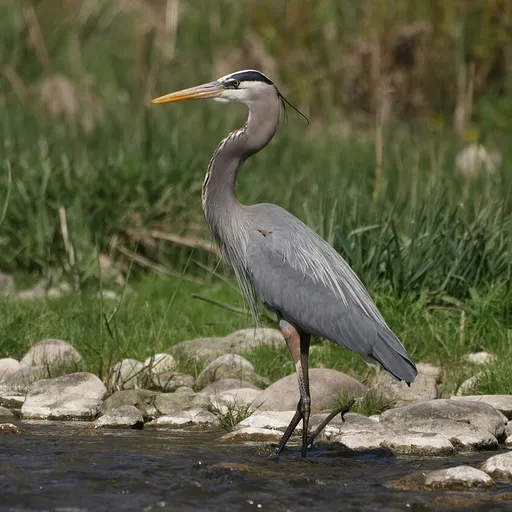
Great Blue Heron
Ardea herodias
Least Concern
Listen
XC991513 · Doug Hynes · Big Fish Island, Nova Scotia, Canada · CC BY-SA 4.0
Overview
The great blue heron (Ardea herodias) is the largest heron native to North America, characterised as a large wading bird commonly found near the shores of open water and wetlands. It is classified as Least Concern on the IUCN Red List and can adapt to various environments, from freshwater marshes to heavily developed areas, provided fish-bearing water is available.
Identification
- Head-to-tail length of 91–137 cm, height of 115–138 cm, and wingspan of 167–201 cm.
- Slaty flight feathers, red-brown thighs, and a rusty gray neck with black-and-white streaking down the front.
- A pair of black or slate plumes runs from above the eye to the back of the head, with long, plume-like feathers on the lower neck.
- A dull yellowish bill that turns orange briefly at the start of the breeding season, along with gray lower legs that also become orangey.
Habitat
This species inhabits fresh and saltwater marshes, mangrove swamps, flooded meadows, lake edges, and shorelines across most of North and Central America, as well as northwestern South America, the Caribbean, and the Galápagos Islands. They rarely venture far from bodies of water and usually nest in trees or bushes near the water's edge, often on islands to minimise predation.
Diet
As an apex predator, the great blue heron primarily feeds on fish, particularly small to medium-sized species, but also consumes amphibians, reptiles, invertebrates, and small mammals. It forages by wading slowly through shallow water and quickly spearing prey with its long, sharp bill, though it may also drop from the air or hover over the surface.
Did you know?
At the Stanley Park colony in Vancouver, British Columbia, healthy nesting populations have been maintained right next to a main entrance and tennis courts, demonstrating the species' remarkable tolerance for human presence.
Sources
- Wikipedia · CC BY-SA 4.0
- Wikidata · CC0 1.0