
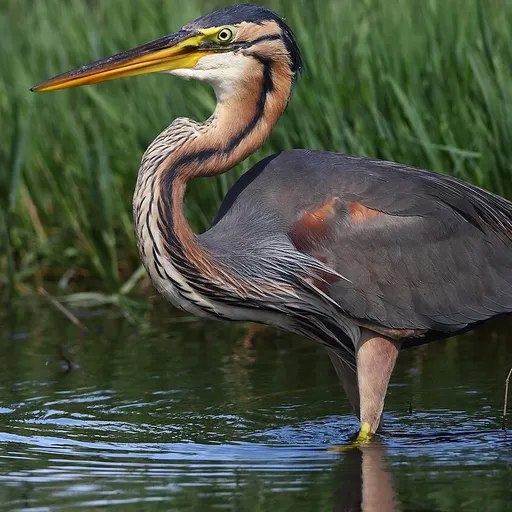
Purple Heron
Ardea purpurea
Least Concern
Listen
XC935642 · Philippe_Grange · Arrondissement de la Roche-sur-Yon (near La Roche-sur-Yon), Vendée, Pays de la Loire, France · CC0 1.0
Overview
The purple heron (Ardea purpurea) is a wide-ranging heron species that breeds across Africa, central and southern Europe, and the southern and eastern Palearctic. Although it is similar in appearance to the more common grey heron, it is slightly smaller, more slender, and significantly more evasive, favouring densely vegetated habitats near water.
Identification
- A slender, large heron measuring 78–97 cm in length with a 120–152 cm wingspan, appearing somewhat hollow-chested and less robust than the grey heron.
- Adults feature dark reddish-brown plumage with a black forehead and crown, a chestnut breast, and a black belly, contrasted by a long, powerful brownish-yellow beak and yellow eyes.
- A distinctive slender, dangling crest extends down the back of the neck, while the legs are brown at the front and yellowish behind.
- The call is a harsh, high-pitched "frarnk," quieter and less frequent than that of the grey heron.
Habitat
This species inhabits marshes, lagoons, lakes, and mangrove swamps surrounded by dense vegetation, with a particular preference for Phragmites reed beds. Its range spans a mostly Palearctic distribution, extending from Portugal across central and southern Europe, North Africa, and the Indian subcontinent to the Philippines. Western populations migrate between breeding and wintering habitats, while African and tropical-Asian populations are primarily sedentary.
Diet
The purple heron feeds in shallow water, stalking prey or standing in ambush to grab it with its powerful beak. Its diet consists mainly of fish, small mammals, and amphibians, but also includes snakes, lizards, crustaceans, water snails, insects, and spiders. Terrestrial beetles are its most common insect prey, followed by water beetles and aquatic larvae.
Did you know?
The bird’s long toes allow it to walk directly on floating vegetation or across bushes without attempting to grip the branches. It is also a surprisingly versatile forager that has been observed eating other nestling birds, snakes, and lizards alongside its primary prey of fish and rodents.
Sources
- Wikipedia · CC BY-SA 4.0
- Wikidata · CC0 1.0