
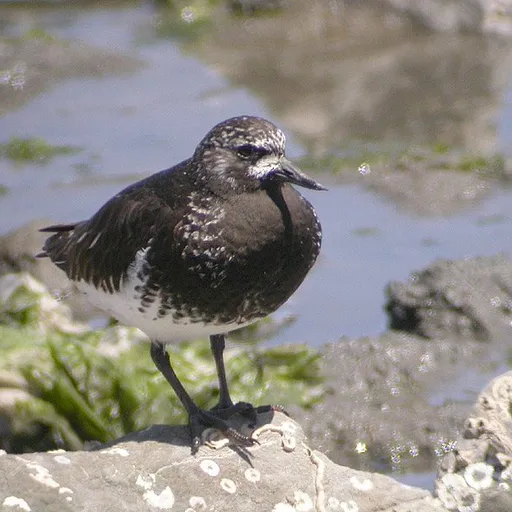
Black Turnstone
Arenaria melanocephala
Least Concern
Overview
The black turnstone (Arenaria melanocephala) is a small wading bird native to the west coast of North America. It is classified as Least Concern on the IUCN Red List, with a world population estimated at 95,000 individuals.
Identification
- 22–25 cm long with a black, slightly upturned bill and blackish-brown legs with a reddish tinge.
- Breeding adults have a black head and breast with a white spot between the eye and bill, while winter plumage is largely dark brown.
- In flight, shows a white wingbar, white shoulder patch, and a white tail with a broad black band.
- Produces a rattling trill that is higher and less harsh than that of the ruddy turnstone.
Habitat
Breeds in western Alaska, primarily in the Yukon–Kuskokwim Delta, where it nests near coasts, rivers, or lakes. Winters on rocky shores along the Pacific coast from southern Alaska to north-west Mexico, occasionally appearing on beaches, mudflats, and man-made structures.
Diet
Feeds mainly on invertebrates such as crustaceans and mollusks in winter, and insects during the breeding season, also consuming seeds, eggs, and carrion. Uses its bill to turn over stones, algal mats, and other objects to access hidden prey.
Did you know?
The bird produces a soft, purring call specifically used to communicate with its young chicks.
Sources
- Wikipedia · CC BY-SA 4.0
- Wikidata · CC0 1.0