
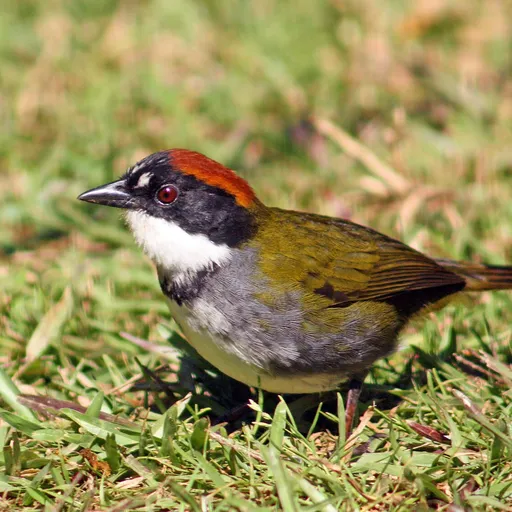
Chestnut-capped Brushfinch
Arremon brunneinucha
Least Concern
Listen
XC250502 · Niels Krabbe · Pichincha: Tandayapa ridge 3 km SSW Tandayapa, Ecuador · CC BY-SA 4.0
Overview
The chestnut-capped brushfinch (Arremon brunneinucha) is a species of bird in the family Passerellidae, commonly known as the New World sparrows. It is one of the larger brushfinches and has a highly disjunct distribution ranging from Mexico to Peru. The species is currently assessed as Least Concern on the IUCN Red List, with an estimated population of at least 500,000 mature individuals.
Identification
- Adults feature a chestnut crown and nape separated from a wide black mask by a thin yellowish tawny supercilium, with a small white spot above the lores within the mask.
- Upperparts are olive-green with darker wings and tails, while underparts include a white throat, a thin black band across the upper breast, and grayish lower parts with a whiter belly.
- The species measures 16 to 19.5 cm in length and weighs 32 to 47 g, possessing a black bill and blackish brown legs.
- Song descriptions include high-pitched, slurred whistles and staccato notes such as 'peetee-zeer, peetee-súueet' or 'tseeee-tseeu-pseee-tzzzeeee'.
Habitat
The chestnut-capped brushfinch inhabits the understory of humid to wet forest types in upper tropical and lower temperate zones, including pine-oak forest, cloudforest, and mature secondary forest. Its range extends from Sierra de los Tuxtlas in southern Mexico through Central America and the Andes of Colombia, Ecuador, and Peru, as well as specific mountain ranges in Venezuela. Elevations vary by region, ranging from 700 m to 3,100 m depending on the location.
Diet
The bird feeds primarily on insects and seeds, supplemented by smaller amounts of small fruits. It usually forages singly or in pairs, turning over leaf litter on the ground or moving near the ground in low vegetation. While foraging, it often raises its crown feathers and fluffs its throat, and occasionally attends army ant swarms.
Did you know?
While foraging, the chestnut-capped brushfinch often raises its crown feathers and fluffs the feathers of its throat, a distinctive behaviour observed as it turns over leaf litter on the ground.
Sources
- Wikipedia · CC BY-SA 4.0
- Wikidata · CC0 1.0