
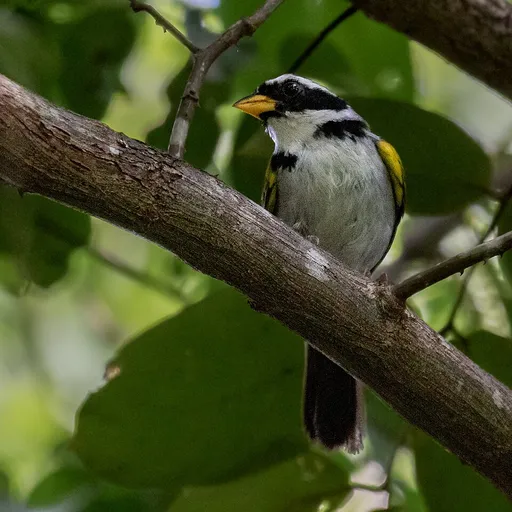
Sao Francisco Sparrow
Arremon franciscanus
Near Threatened
Overview
The Sao Francisco sparrow (Arremon franciscanus) is a Near Threatened species of bird in the family Passerellidae, commonly known as the New World sparrows. It is endemic to east-central Brazil and is considered uncommon to rare within its limited range.
Identification
- Approximately 21 cm long and weighing 21 to 25 g.
- Adult males feature a black crown with a thin whitish central stripe, a white supercilium extending to the nape, and a white throat.
- Upperparts are mostly greenish olive, while underparts are white with an oval black spot on the upper breast and light gray flanks.
- Possesses an orange-yellow bill with a blackish culmen and brown to dark reddish brown irises.
Habitat
Found in east-central Brazil, specifically in southern Bahia and northern Minas Gerais states, with its range centred on the São Francisco River valley. It primarily inhabits the caatinga biome, characterised by dense deciduous shrubs, and is suspected to occur in taller vegetation transitioning to humid evergreen forest. Elevation ranges between 600 and 1,400 m.
Diet
The diet has not been formally studied but is assumed to consist of insects, seeds, and fruits. Foraging behaviour involves moving on the ground or in very low vegetation.
Did you know?
Females of this species have not yet been formally described. It was formally described only in 1997 by Marcos Raposo, who suggested it is closest in relation to the half-collared sparrow.
Sources
- Wikipedia · CC BY-SA 4.0
- Wikidata · CC0 1.0