
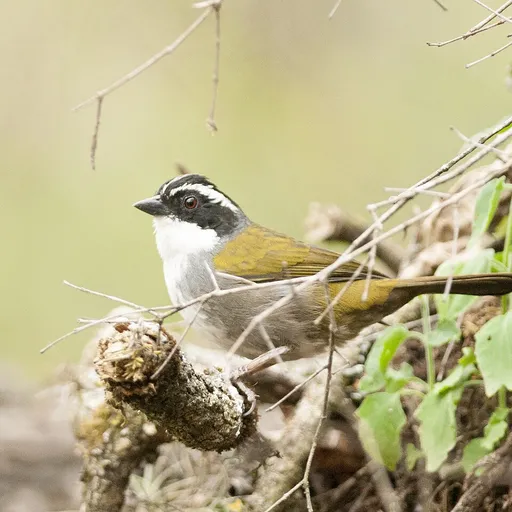
White-browed Brushfinch
Arremon torquatus
Least Concern
Overview
The white-browed brushfinch (Arremon torquatus) is a species of bird in the family Passerellidae. It is found in the southern Andes region spanning Argentina, Bolivia, and Peru. The species is currently assessed as Least Concern by the IUCN, although its population size is unknown and believed to be decreasing.
Identification
- Approximately 19 cm long with a blackish bill, pinkish brown to greyish legs, and dark brown irises.
- Nominate adults feature a black crown with a central grey stripe, black lores, and blackish ear coverts, contrasted by a prominent white supercilium that gives the species its name.
- Upperparts, wings, and tail are olive, while the throat is white with a black band below it; breasts and bellies are whitish or pale grey with flanks tinged olive.
- Song consists of a series of high-pitched whistles lasting approximately three seconds, described as "pze-zee-psee zaa sweee", alongside occasional longer, complex songs and short, sharp calls.
Habitat
The species primarily inhabits the understory and edges of montane evergreen forest, including both primary and secondary growth, with lesser presence in elfin forest. The nominate subspecies occupies elevations between 1,650 and 3,100 m in far southeastern Peru and western Bolivia, while the other two subspecies range from 400 to 1,200 m across Bolivia and northwestern Argentina.
Diet
The white-browed brushfinch consumes insects, seeds, and fruit, foraging either singly or in pairs. It typically forages on the ground or in low vegetation, often flipping leaf litter with its bill.
Did you know?
The species has a complicated taxonomic history, having been known as the "stripe-headed brushfinch" before being split into eight separate species in 2010 following a study that redefined the white-browed brushfinch.
Sources
- Wikipedia · CC BY-SA 4.0
- Wikidata · CC0 1.0