
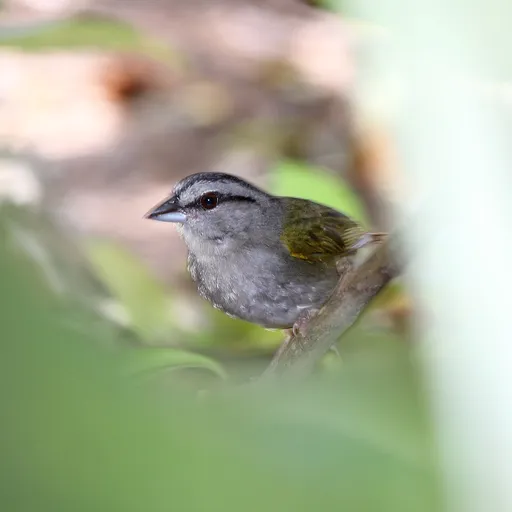
Green-backed Sparrow
Arremonops chloronotus
Least Concern
Overview
The green-backed sparrow, scientifically known as Arremonops chloronotus, is a species of bird in the family Passerellidae, the New World sparrows. It is currently classified as Least Concern on the IUCN Red List, with an estimated population of at least 20,000 mature individuals, although this number is believed to be decreasing.
Identification
- Adults possess a slate gray head with distinct black or brownish-black strips on the crown, a spot in front of the eye, and a long stripe behind the eye.
- Upperparts, tail, and wings are bright olive green, with canary yellow on the edges of the wings; the chin and throat are dull white, and the belly is white.
- Measures between 15 and 16 cm in length and weighs 24 to 31 g, with a black or brownish-black maxilla, a blue-gray mandible, and pinkish legs.
- Songs vary by subspecies, ranging from an even-paced series of whistles to a longer, accelerating sequence, accompanied by a soft, high-pitched 'tit' or 'tip' call.
Habitat
Found in Belize, Guatemala, Honduras, and Mexico, the species primarily inhabits the edges of tropical semi-deciduous and evergreen forest, savanna, and secondary forest. The subspecies A. c. twomeyi prefers arid scrub and thorn forest in north-central Honduras. Its elevation range is estimated between 750 m and 900 m depending on the source.
Diet
Although its diet has not been formally studied, it is assumed to consist of insects, seeds, berries, and soft fruit. The green-backed sparrow typically forages on the ground, usually acting singly or in pairs.
Did you know?
The two subspecies produce distinctly different songs, with the nominate being even-paced and the A. c. twomeyi subspecies delivering a longer, slightly accelerating series. Both, however, share a soft, high-pitched 'tit' or 'tip' call.
Sources
- Wikipedia · CC BY-SA 4.0
- Wikidata · CC0 1.0