
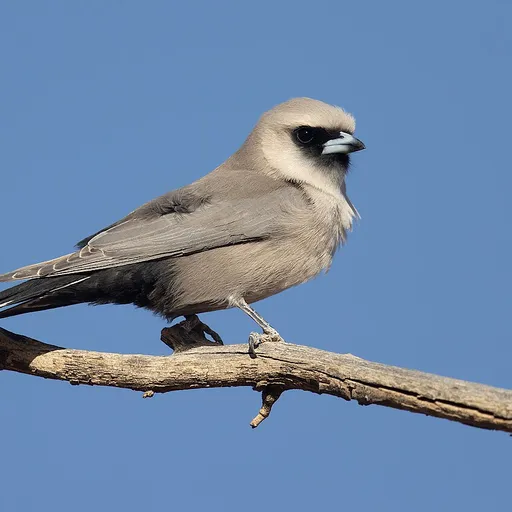
Black-faced Woodswallow
Artamus cinereus
Least Concern
Overview
The black-faced woodswallow (Artamus cinereus) is the most widespread species in the family Artamidae, native to Australia, New Guinea, and the Sunda Islands including Timor. It is classified as Least Concern on the IUCN Red List, although significant regional declines have been recorded on the Cape York Peninsula.
Identification
- Length of 18–19 cm with ash-grey plumage that is lighter around the breast and darker on the wings.
- Distinctive black face mask extending from the base of the bill up to and around the eyes, paired with a blue-grey beak featuring a black tip.
- Black tail with a white tip, and silver underwings; subspecies vary by having either black or white tail vents.
- Soft voice characterised by chiff, chap, and chattering calls that may include vocal mimicry.
Habitat
Broadly distributed across most of Australia except for the southeastern coastal margin, as well as in New Guinea and the Sunda Islands. It prefers open eucalypt woodlands, scrub, and spinifex in arid and semi-arid regions, while favouring open woodlands and grasslands in tropical savannah. The species is mainly sedentary but can be partly nomadic.
Diet
Primarily insectivorous, this species is an aerial feeder that soars, hovers, and dives to catch prey such as moths, or feeds on the ground to gather insects. They possess brush-like tongues used for gleaning nectar and will occasionally feed on flowers.
Did you know?
Woodswallows are communal breeders where numerous birds participate in feeding the young, likely an adaptation to the erratic climate of arid and semi-arid conditions. Their efficient defence of territory against predators also benefits other species, such as the endangered golden-shouldered parrot, which often feed nearby to reduce their own predation risk.
Sources
- Wikipedia · CC BY-SA 4.0
- Wikidata · CC0 1.0