
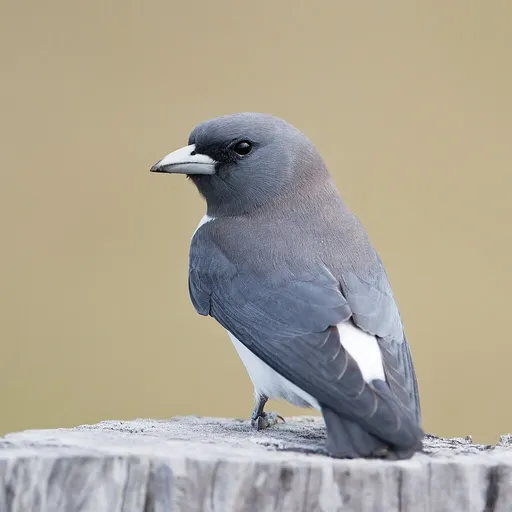
White-breasted Woodswallow
Artamus leucorynchus
Least Concern
Overview
The white-breasted woodswallow (Artamus leucorynchus) is a medium-sized passerine bird found across Australasia, despite its name it belongs to the family Artamidae rather than being a true swallow. It is a common and widespread species, classified as Least Concern on the IUCN Red List due to its stable and large population.
Identification
- Dark grey head and neck contrasting with white underparts, and a completely black tail, which distinguishes it from the related great woodswallow.
- Stout bluish-grey bill with a black tip and short, black tail.
- Males and females are identical in appearance, while juveniles display brownish, heavily striated plumage on the head and mantle.
- Size reaches a maximum of 18 centimetres in length with a weight between 35 and 45 grams.
Habitat
Breeding from the Andaman Islands east through Indonesia and northern Australia, this species inhabits forests, open woodlands, and semi-arid plains near watercourses. They are found at elevations ranging from sea level to 1,500 m, with southern flocks exhibiting partial migration patterns.
Diet
Primarily insectivorous, this bird feeds on insects caught in flight or from perches, and occasionally consumes flower nectar. Foraging occurs on the ground, in the tree canopy, or communally when catching large prey items.
Did you know?
Despite possessing a bifurcated, brush-tipped tongue typically associated with nectar feeders, the white-breasted woodswallow is primarily an insectivore. Additionally, these birds are known for their cooperative breeding behaviour, where non-parent individuals assist in caring for offspring.
Sources
- Wikipedia · CC BY-SA 4.0
- Wikidata · CC0 1.0