
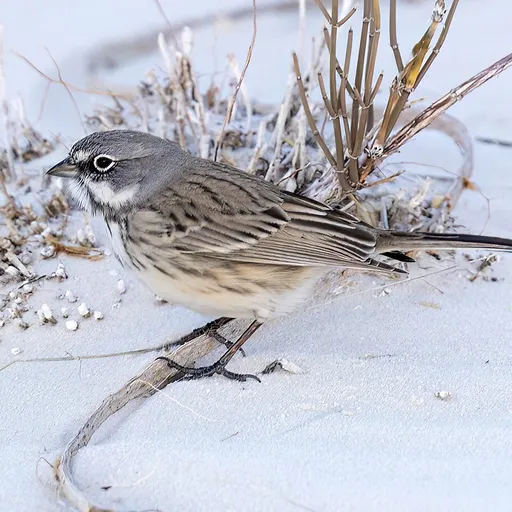
Sagebrush Sparrow
Artemisiospiza nevadensis
Least Concern
Overview
The sagebrush sparrow, Artemisiospiza nevadensis, is a species of bird in the family Passerellidae, also known as the New World sparrows. It is found in the mountain western United States and northern Mexico. The species is assessed as Least Concern by the IUCN due to its extremely large range and stable population of at least 5.4 million mature individuals.
Identification
- Adults possess a pale to medium gray head and nape with a white to buff-white patch above the dusky gray lores and a white eye-ring.
- Back, rump, and uppertail coverts are brownish with fuscous streaks, while the tail is brownish black with white outer webs on the outermost pair of feathers.
- Underparts are mostly white, sometimes featuring a small black spot on the breast, with pale buff flanks bearing brown streaks.
- Males sing a series of short musical buzzes on different frequencies with abrupt beginnings and endings, and produce a short musical 'tink' contact call.
Habitat
The sagebrush sparrow has a disjunct distribution across the mountain western United States and northern Mexico, with a large contiguous range spanning from western Oregon and Idaho to Arizona, New Mexico, and Texas. In breeding habitats, it is strongly associated with big sagebrush (Artemisia tridentata) but is also found in mixed stands of bitterbrush, saltbush, and greasewood. During migration and on wintering grounds, it favours similar shrub mixes as well as arid grasslands, cactus scrublands, and areas with yucca, mesquite, or inkweed.
Diet
During the breeding season, the species feeds on adult and larval insects, spiders, seeds, small fruits, and other plant parts, whereas in the non-breeding season its diet consists mostly of seeds. Foraging typically occurs on the ground under or near shrubs, or by gleaning above the ground in vegetation, using a hopping or walking motion. It is usually seen in pairs during the breeding season and in small flocks, sometimes mixed with other sparrow species, during winter.
Did you know?
Although most migratory songbirds pair on the breeding grounds, many sagebrush sparrows form pairs during the winter. Nest-building is the sole responsibility of the female, who constructs an open cup from twigs and coarse grass lined with fine grass, feathers, and hair.
Sources
- Wikipedia · CC BY-SA 4.0
- Wikidata · CC0 1.0