
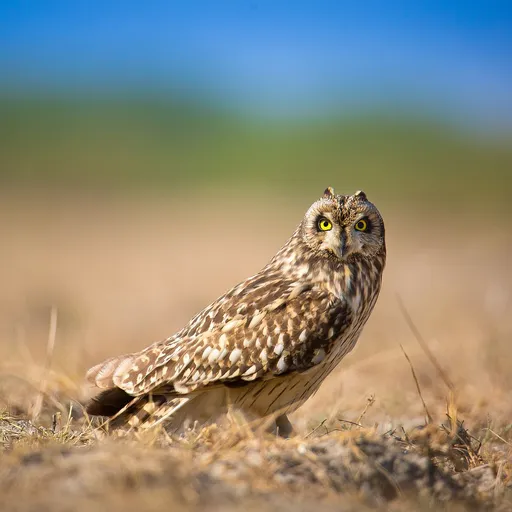
Short-eared Owl
Asio flammeus
Least Concern
Listen
XC1105612 · Kevin Guille · Birky, Lyubeshivs'kyi district, Volyn Oblast, Ukraine · CC0 1.0
Overview
The short-eared owl (Asio flammeus) is a medium-sized, widespread grassland species in the family Strigidae. It belongs to the genus Asio, known as eared owls, which possess tufts of feathers resembling mammalian ears, though the short-eared owl's very short tufts are usually not visible. This species has one of the most widespread distributions of any bird, occurring on all continents except Antarctica and Australia.
Identification
- Medium-sized owl measuring 34–43 cm in length with a wingspan of 85–110 cm, featuring mottled tawny to brown plumage, a barred tail and wings, and a significantly streaked upper breast.
- Possesses large yellow-orange eyes exaggerated by black rings and large whitish discs of plumage, creating the appearance of wearing mascara.
- Characterised by a short, strong, hooked black bill, broad wings, and a flight described as 'moth or bat-like' due to irregular, floppy wingbeats.
- Produces a scratchy, bark-like call described as raspy 'waowk, waowk' or 'toot-toot-toot-toot-toot', and may emit a loud 'eeee-yerp' on breeding grounds.
Habitat
The short-eared owl inhabits open country and grasslands, including prairies, tundra, savannas, and meadows. It breeds across Europe, Asia, North and South America, the Caribbean, Hawaii, and the Galápagos Islands, and is partially migratory, moving south in winter from northern areas. The species may relocate to areas of higher rodent populations and wanders nomadically during years when vole populations are low.
Diet
Hunting occurs mostly at night but is also diurnal and crepuscular, with daylight activity coinciding with the high-activity periods of voles, its preferred prey. The owl hunts by flying only feet above the ground in open fields, swooping down upon prey feet-first, and its diet consists mainly of rodents such as voles, rabbits, mice, ground squirrels, shrews, rats, bats, muskrats, and moles. It occasionally depredates smaller birds like shorebirds, terns, and gulls, and supplements its diet with insects such as roaches, grasshoppers, beetles, katydids, and caterpillars.
Did you know?
The short-eared owl is known to lure predators away from its nest by appearing to have a crippled wing.
Sources
- Wikipedia · CC BY-SA 4.0
- Wikidata · CC0 1.0