
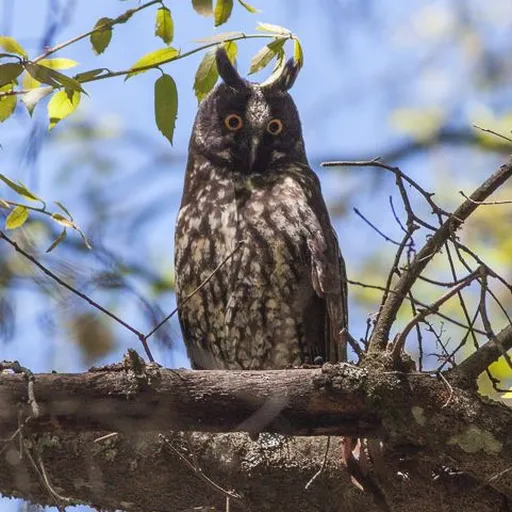
Stygian Owl
Asio stygius
Least Concern
Overview
The Stygian owl (Asio stygius) is a medium-sized typical owl found across parts of Mexico, Central America, the Caribbean, and South America. Classified as Least Concern by the IUCN, it maintains a very large range and a population estimated between 50,000 and 500,000 mature individuals.
Identification
- Size ranges from 38 to 46 cm in length, with a weight of approximately 400 to 675 g.
- Plumage is very dark with blackish facial discs bordered in pale colours, a whitish forehead, and long dark head feathers projecting upward as 'ears'.
- Upperparts feature buff streaks and bars, while underparts are dingy buff with dark brown or blackish barring and streaks.
- Eyes are yellow but may appear crimson under certain lighting, paired with a blue-black bill and dark greyish or brownish-pink feet.
- Vocalisations include a single deep, emphatic 'woof' or 'wupf', a low 'hu', and a muffled 'boo', while females may produce short screamed 'rre-ehhr' or catlike 'miah' calls.
Habitat
This species inhabits a wide variety of landscapes from sea level to 3,000 m elevation, preferring open environments rather than dense forests or pure grasslands. Its habitats include montane pine, pine-oak, and cloud forests, thorn scrub, cerrado, pine plantations, and even urban parks. It is resident throughout its range, which includes Mexico, Central America, Cuba, Hispaniola, and ten South American countries.
Diet
Wholly nocturnal, the Stygian owl primarily feeds on birds, often catching them on their nighttime roosts. Its diet also includes bats, some mammals such as Hispaniolan solenodons, frogs, and insects. Notably, rodents do not appear to form part of its diet, which contrasts with the habits of most other owl species.
Did you know?
The owl preys on bats, which are seldom taken by other owl species. It also consumes Hispaniolan solenodons, which are unique to the island of Hispaniola.
Sources
- Wikipedia · CC BY-SA 4.0
- Wikidata · CC0 1.0