
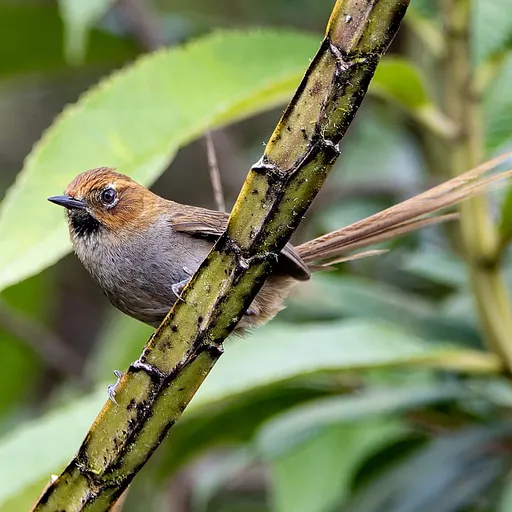
Black-throated Thistletail
Asthenes harterti
Least Concern
Overview
The black-throated thistletail (Asthenes harterti) is a species of ovenbird in the subfamily Furnariinae, endemic to the Andes of western Bolivia. The IUCN classifies the species as Least Concern, although its population is believed to be decreasing due to habitat reduction.
Identification
- A medium-sized bird measuring 17 to 18 cm in length with a long, deeply forked tail.
- The nominate subspecies features a rufous-brown face with a light brown supercilium and a black throat marked with whitish streaks, while the crown, back, and tail are dark rufescent brown.
- The subspecies bejaranoi is distinguished by ochraceous tones on the face and neck, along with paler underparts and ochraceous flanks.
- The species vocalises with a series of emphatic, squeaky notes that accelerate and then slow, ending with a slight descent, and issues a rodent-like 'pseea' alarm call.
Habitat
This species inhabits páramo grasslands, elfin forest, the ecotone at the tree line, and the edges of cloudforest in the Andes of western Bolivia. Its range is restricted to the departments of La Paz, Cochabamba, and Santa Cruz, occurring at elevations between 2,900 and 3,400 m. It is a year-round resident throughout its distribution.
Diet
The black-throated thistletail feeds predominantly on arthropods, with seeds making up a minor portion of its diet. It forages singly or in pairs, primarily within the understory, though it occasionally forages at higher levels. Prey is obtained by gleaning from foliage, small branches, moss, grass, and rocks.
Did you know?
The bird was previously classified in the genus Schizoeaca, but genetic data revealed that this group is embedded within Asthenes, confirming these taxa as separate species rather than conspecifics. Its known nest is a unique oval mass with a side entrance, constructed from moss and twigs and placed on a clump of grass.
Sources
- Wikipedia · CC BY-SA 4.0
- Wikidata · CC0 1.0