
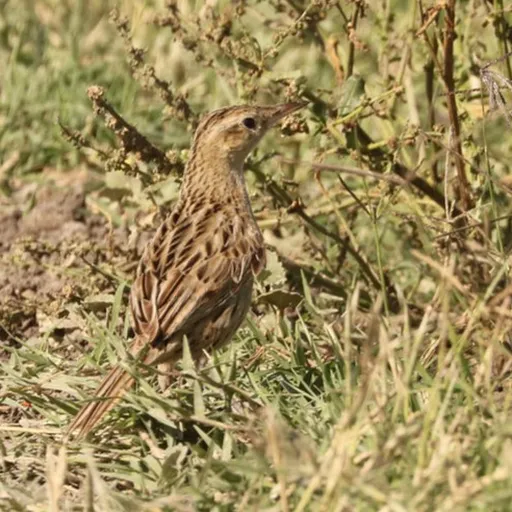
Hudson's Canastero
Asthenes hudsoni
Near Threatened
Overview
Hudson's canastero (Asthenes hudsoni) is a Near Threatened bird species within the ovenbird family Furnariidae. It is a grassland specialist found in parts of southern South America and is now known to be migratory, with breeding populations restricted to specific pampas regions.
Identification
- Approximately 18 cm in length with a long bill and light brown legs.
- Sandy brown upperparts covered in conspicuous blackish and silvery streaks, with a narrow pale buff supercilium on the face.
- Buff underparts with blackish streaks on the flanks and a chin that is often whitish with a yellow or orange-rufous tinge.
- Song consists of a short ascending trill.
Habitat
It inhabits temperate grasslands, preferably near fresh or brackish marshes, featuring tall grasses like Paspalum quadrifarium and sedges mixed with short turf or bare ground. The range covers southeastern Brazil, Uruguay, and eastern Argentina, from sea level up to 950 m in elevation.
Diet
The bird feeds on adult and larval arthropods. It forages singly or in pairs, gleaning its prey from the ground and low vegetation.
Did you know?
Although traditionally considered a year-round resident, recent research has revealed that Hudson's canastero is actually a migratory species, with records in northern Argentina and Uruguay corresponding to wintering birds rather than permanent residents.
Sources
- Wikipedia · CC BY-SA 4.0
- Wikidata · CC0 1.0