
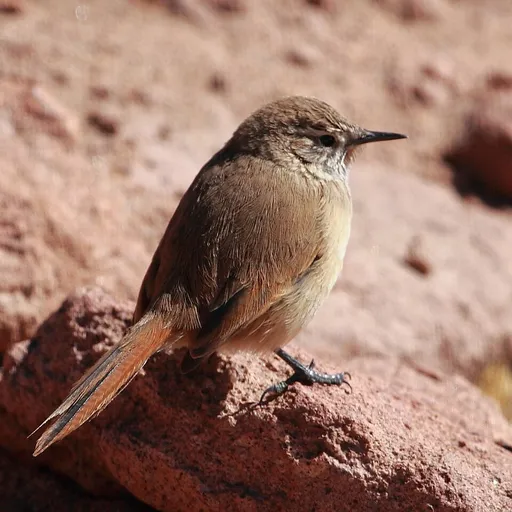
Cordilleran Canastero
Asthenes modesta
Least Concern
Overview
The cordilleran canastero (Asthenes modesta) is a small bird in the ovenbird family Furnariidae, widely distributed across South America. It is classified as Least Concern on the IUCN Red List due to its extensive range, though its population is believed to be decreasing.
Identification
- Size: 15 to 16 cm (5.9 to 6.3 in) long, weighing 13 to 22 g (0.46 to 0.78 oz), making it one of the smaller canasteros.
- Plumage: Dull dark brown upperparts with a rufescent tinge on the rump and tail coverts; underparts feature an orange-rufous patch on the upper throat, whitish gray-brown streaked breast, and pale brown belly.
- Head and Bill: Brown to dark brown iris, black to dark brownish horn maxilla, and horn to brownish gray mandible with a dark tip.
- Voice: Song is described as an ascending fast trill that ends abruptly, accompanied by a more complex trill with introductory notes; calls include short, low 'pyup' or 'tjit' sounds.
Habitat
Found in Argentina, Bolivia, Chile, and Peru, the species primarily inhabits puna, temperate, and arid to semi-humid grasslands, often with rocky outcrops and scattered small bushes. It also occupies arid montane scrublands, Polylepis thickets, and dry open woodlands, ranging in elevation from near sea level to 4,500 m (14,800 ft).
Diet
The cordilleran canastero feeds on arthropods, usually foraging singly or in pairs. It gleans prey mostly from the ground and, to a lesser extent, from low vegetation.
Did you know?
The bird weaves a cylindrical or spherical nest from twigs, often using thorny ones, with a side entrance lined with feathers and hair. It places this structure in varied locations, including rock crevices, bushes, dirt bank holes, and even abandoned nests of other birds.
Sources
- Wikipedia · CC BY-SA 4.0
- Wikidata · CC0 1.0