
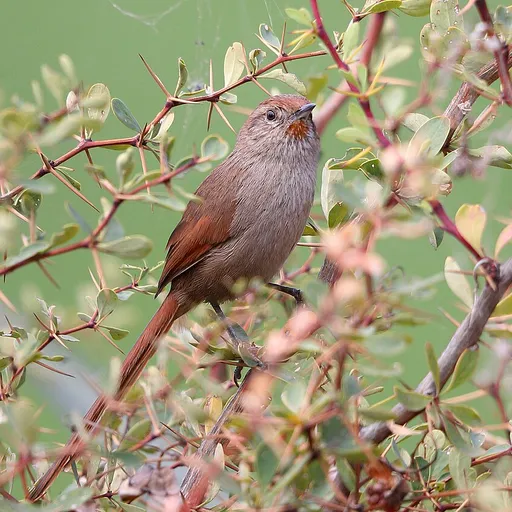
Rusty-fronted Canastero
Asthenes ottonis
Least Concern
Overview
The rusty-fronted canastero (Asthenes ottonis) is a small, endemic bird species found in the Andes of south-central Peru. Classified as Least Concern by the IUCN, it is a year-round resident that is thought to be fairly common despite having a somewhat limited range.
Identification
- Measures 18 to 19 cm in length with a weight of approximately 13 g, featuring a rufous forehead with faint pale streaks and a dull brownish face marked by a grayish buff supercilium.
- Displays rich brown on the crown, back, and rump, with chestnut-rufous uppertail coverts, wings, and tail; the inner tail feathers have dark fuscous shafts.
- The chin and upper throat are light orange-rufous to chestnut-rufous, contrasting with a pale grayish buff lower throat streaked with brownish gray.
- Possesses a dark horn to blackish upper bill and a silvery to dark horn lower bill with a dark tip, along with olive-gray to dark gray legs.
- Produces a song of three high-pitched ascending notes followed by a rapidly descending series described as 'bsee-bzéé-bzee-di-di-di-di-d-d-d', alongside 'veer' and 'djeeh' calls.
Habitat
Endemic to the Andes of Peru's Huancavelica, Ayacucho, Apurímac, and Cuzco departments, this species inhabits semi-humid to arid montane scrublands and the edges of Polylepis woodlands. It occupies elevations ranging between 2,750 and 4,000 m.
Diet
Although its diet and foraging behaviour are not well known, the rusty-fronted canastero is thought to feed on arthropods gleaned from low vegetation and the ground. It is usually observed singly or in pairs.
Did you know?
Despite being treated historically as a subspecies of the canyon canastero, genetic data reveal that the rusty-fronted canastero is most closely related to the eye-ringed thistletail (A. palpebralis).
Sources
- Wikipedia · CC BY-SA 4.0
- Wikidata · CC0 1.0