
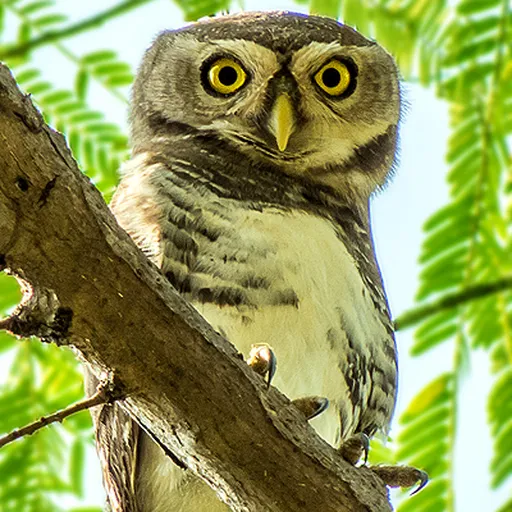
Forest Owlet
Athene blewitti
Endangered
Listen
XC983332 · Dinesh Chaudhary · Dang (near Gaykhas), Gujarat, India · CC BY-SA 4.0
Overview
The forest owlet (Athene blewitti) is a small owl species endemic to the forests of central India. It is currently classified as Endangered on the IUCN Red List, with an estimated population of fewer than 1,000 mature individuals.
Identification
- Small and stocky bird measuring 23 cm with a relatively large skull and beak.
- Dark grey-brown upperparts, a solid brown upper breast, and barred sides with a white central wedge on the lower breast that may be unmarked in males.
- Heavily banded wings and tail with white trailing edges, featuring a dark carpal patch on the underwing visible in flight.
- Pale facial disc with yellow eyes; crown and back have fewer and fainter spots compared to the spotted owlet.
- Vocalisations include a short, mellow, and disyllabic song described as "oh-owow," along with specific territorial and alarm calls.
Habitat
Found in dense to open deciduous forests in central India, particularly in Maharashtra, Madhya Pradesh, Odisha, Chhattisgarh, and Gujarat. The species prefers habitats containing trees such as Tectona grandis, Lagerstroemia parvifolia, Boswellia serrata, and Lannea grandis. Nesting cavities are typically located between 5.0 and 8.0 m high in species like Soymida febrifuga.
Diet
Forages by sitting still on perches and flicking its tail rapidly to hunt, primarily targeting lizards and skinks which make up nearly 60% of its diet. Rodents account for approximately 15% of its prey, with smaller proportions of birds, invertebrates, and frogs.
Did you know?
Considered extinct for over a century after its last recorded sighting in 1884, the species was rediscovered in 1997 only after it was revealed that earlier failed searches were caused by a stolen museum specimen with falsified locality data.
Sources
- Wikipedia · CC BY-SA 4.0
- Wikidata · CC0 1.0