
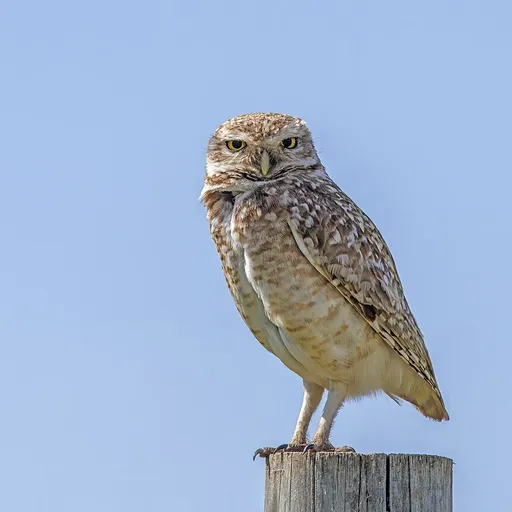
Burrowing Owl
Athene cunicularia
Least Concern
Overview
The burrowing owl is a small, long-legged, primarily terrestrial species of owl native to the open landscapes of North and South America. Despite its name, it rarely constructs its own dwelling, instead repurposing disused burrows or tunnels excavated by other species such as badgers, foxes, and ground squirrels.
Identification
- Measures 19–28 cm in length with a wingspan of 50.8–61 cm and a weight of 140–240 g, making an average adult slightly larger than an American robin.
- Adults feature brown heads and wings with white spotting, and white chests and abdomens marked with variable brown spotting or barring.
- Possesses prominent white eyebrows, a white 'chin' patch, and a flattened facial disc without ear tufts.
- Has grayish legs that are longer than those of most other owl species, aiding in sprinting on the ground.
Habitat
Native to the open landscapes of the New World, ranging from southern Canadian provinces through Mexico and across South America, excluding the dense Amazon rainforest interior and highest Andes ranges. It prefers open, dry areas with low vegetation, including grasslands, rangelands, deserts, and agricultural areas, often nesting in burrows within these habitats.
Diet
Eats a highly variable diet consisting of invertebrates and small vertebrates, including large insects, small rodents, lizards, snakes, and other birds. It also consumes fruits and seeds, particularly from prickly pear and cholla cacti, and may use mammal dung to attract dung beetles for food.
Did you know?
When threatened, the owl retreats to its burrow and produces rattling and hissing sounds similar to those of a rattlesnake, an effective defensive strategy known as acoustic Batesian mimicry that deters predators familiar with snake dangers.
Sources
- Wikipedia · CC BY-SA 4.0
- Wikidata · CC0 1.0