
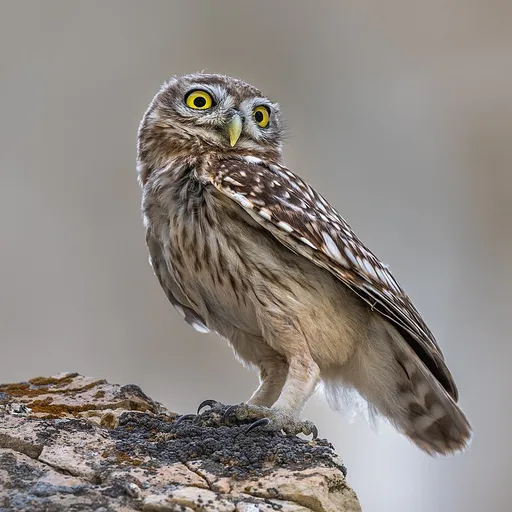
Little Owl
Athene noctua
Least Concern
Listen
XC878963 · Lionel Boucq · Arrondissement de Tournai-Mouscron (near Comines-Warneton), Hainaut, Wallonia, Belgium · CC0 1.0
Overview
The little owl, Athene noctua, is a small, cryptically coloured raptor found across temperate and warmer parts of Europe, the Palearctic, and North Africa. It is a common species with a stable global population, leading to its assessment as 'least concern' on the IUCN Red List. Also known as the owl of Athena or Minerva, it inhabits a variety of open environments and is partly diurnal.
Identification
- Size and shape: Small owl, approximately 22 cm in length with a 56 cm wingspan, featuring a flat-topped head, plump compact body, and short tail.
- Plumage: Greyish-brown upperparts spotted, streaked, and barred with white; pale underparts streaked with darker colours.
- Facial features: Large head with yellow eyes and white 'eyebrows' that create a stern, frowning expression.
- Voice: Emits a querulous kiew, kiew call, accompanied by whistling, trilling, or duetting calls during the breeding season.
Habitat
This sedentary species occupies open countryside across Europe, Asia, and North Africa, including agricultural land, orchards, woodland verges, parks, steppes, and semi-deserts. It also frequents treeless areas such as dunes, ruins, and quarries, and is known to venture into villages and suburbs. In the United Kingdom, it is primarily a bird of the lowlands, usually occurring below 500 m, whereas in continental Europe and Asia it has been recorded at elevations up to 3,600 m.
Diet
The little owl perches in elevated positions to swoop down on prey, which includes insects, earthworms, other invertebrates, and small vertebrates such as amphibians, reptiles, birds, and mammals. It may also pursue prey on the ground and caches surplus food in holes or hiding places. Studies of regurgitated pellets indicate that mammals constitute 20–50% of the diet, including mice, rats, and shrews, while insects make up 24–49%.
Did you know?
The little owl has been culturally associated with wisdom for millennia, appearing on a Greek tetradrachm coin from 500 BC and on the modern Greek one-euro coin as a symbol of the goddess Athena. Historically, it was used in 'cottage hunting' in Italy and Germany, exploiting the aggressive mobbing behaviour of other birds to help capture game like skylarks.
Sources
- Wikipedia · CC BY-SA 4.0
- Wikidata · CC0 1.0