
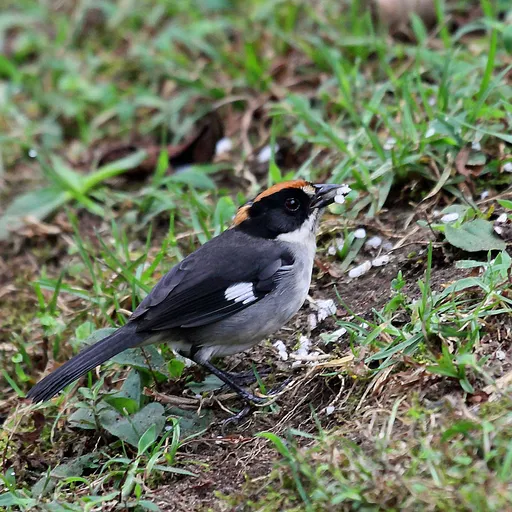
White-winged Brushfinch
Atlapetes leucopterus
Least Concern
Listen
XC250518 · Niels Krabbe · Zamora-Chinchipe: 1 km N Valladolid, Ecuador · CC BY-SA 4.0
Overview
The white-winged brushfinch is a species of bird in the family Passerellidae, native to the Andes of Ecuador and Peru. It is a year-round resident that exists in three subspecies, though taxonomic treatments vary on whether one subspecies constitutes a separate species.
Identification
- Approximately 15.5 cm in length, with plumage that is similar across sexes but varies significantly by subspecies.
- Nominate adults possess a russet stripe from the forecrown to the nape, a blackish face with a buff-white spot above the lores, and a wide white lower cheek edged with a thin black line.
- Upperparts and tail are dark gray, with wings featuring white bases on the primaries and white marginal coverts; underparts are mostly whitish with speckles on the throat and buffy washes on the flanks.
- Subspecies A. l. paynteri is distinguished by a black forecrown, a creamy hindcrown, and a significantly longer tail than the nominate form.
Habitat
Found across the Andes of Ecuador and Peru, the species inhabits dry to arid woodlands, shrublands, plantations, and gardens, with some populations preferring the edges of humid montane forests. Elevation ranges vary by subspecies, from 400 to 2,600 m, with A. l. paynteri restricted to 1,700–2,200 m.
Diet
Although not extensively studied, the diet appears to consist of insects, seeds, berries, and other fruits. The bird forages on the ground by scratching in leaf litter or slightly above it in vegetation, typically in pairs or small family groups, though it may join mixed-species flocks of up to 30 individuals after the breeding season.
Did you know?
The song of the A. l. paynteri subspecies has been described as a 'pleasant musical chew-chew tee-tee', contrasting with the 'high, descending tseeu' call of A. l. dresseri.
Sources
- Wikipedia · CC BY-SA 4.0
- Wikidata · CC0 1.0