
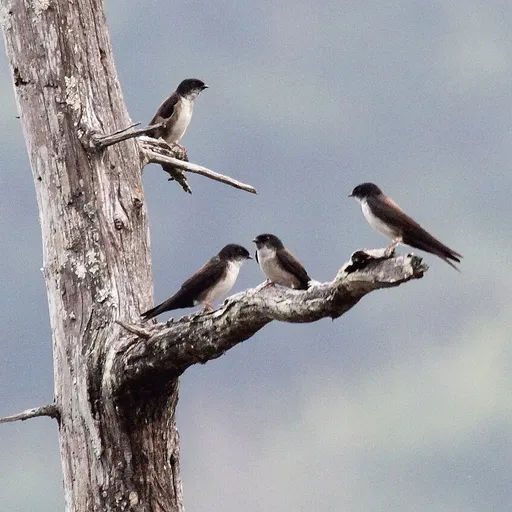
Black-capped Swallow
Atticora pileata
Least Concern
Overview
The black-capped swallow (Atticora pileata) is a small species of bird in the family Hirundinidae, commonly known as the swallows and martins. It is classified as Least Concern by the IUCN, with an estimated population of at least 50,000 mature individuals that is believed to be decreasing.
Identification
- Length 11.5 to 13.5 cm and weight approximately 12 g, with both sexes displaying identical plumage.
- Glossy black head featuring brown-speckled white cheeks and throat, contrasting with a sepia brown back and dull sooty black, forked tail.
- White centre to the breast and belly, flanked by grayish brown flanks and sooty black undertail coverts.
- Brown iris, black bill, and brown legs and feet; juveniles appear browner and less glossy with a buffy chin and pale cinnamon edges on upperparts.
- Calls include a buzzy electric "pzzzzzeeet!" and a more liquid "pweeet-pweeet".
Habitat
Found in a disjunct distribution across central and southwestern Chiapas, most of Guatemala, and parts of El Salvador and Honduras, the species inhabits the interior, edges, and clearings of pine-oak forest, pine forest, and cloudforest. It occupies elevational ranges that vary by source, generally spanning between 1,000 m and 3,100 m in the subtropical and temperate zones. The species is a year-round resident, though it is known to wander in Chiapas and may benefit from human activities that increase edge habitat near roads and farm clearings.
Diet
The black-capped swallow feeds exclusively on insects captured in flight, although specific dietary details remain lacking. It sometimes forages in small flocks.
Did you know?
Nesting behaviour involves creating cup nests of pine needles, leaves, twigs, and mud within burrows in earthen banks or rock crevices, with both sexes participating in construction and provisioning, despite uncertainty over whether the birds can excavate their own burrows or rely on abandoned ones.
Sources
- Wikipedia · CC BY-SA 4.0
- Wikidata · CC0 1.0