
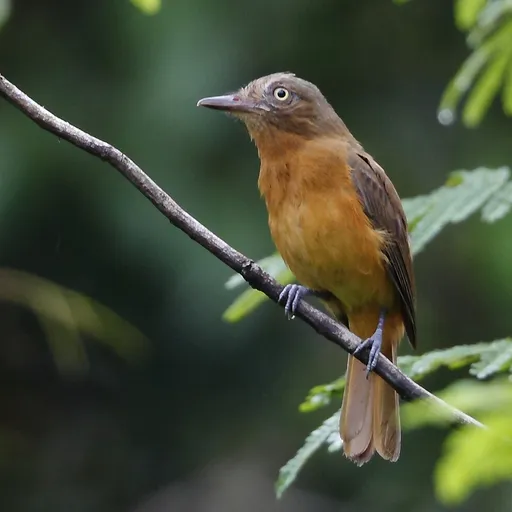
White-eyed Attila
Attila bolivianus
Least Concern
Overview
The white-eyed attila, also known as the dull-capped attila, is a passerine bird in the tyrant flycatcher family Tyrannidae. It is classified as Least Concern by the IUCN and is found across parts of South America.
Identification
- Measures 19 to 22 cm in length and weighs 40 to 45 g, with both sexes sharing the same plumage.
- Characterised by a grayish rufous-brown head, rufous-brown upperparts with a bright cinnamon-rufous rump, and cinnamon-rufous underparts that are paler on the belly.
- Features a pale yellowish white iris, a horn-colored maxilla, a pinkish-tinged horn-colored mandible, and blue-gray legs and feet.
- Song consists of a slow, rising series of about 10-15 fluted notes or rising whistles that terminate in a lower, melancholy note, accompanied by quiet pup notes and woodpecker-like chatters.
Habitat
Inhabits riverine landscapes, including várzea and other swampy forests on river banks and islands in the Amazon Basin, and gallery forest in the Pantanal. The species ranges across Bolivia, Brazil, Colombia, and Peru, with elevations reaching up to 150 m in Colombia and 500 m in Brazil.
Diet
Primarily feeds on large arthropods and also includes fruit in its diet. It forages singly or in pairs within the forest understory to midstory, occasionally joining mixed-species feeding flocks. It perches quietly and takes prey and fruit from foliage and branches by briefly hovering after a short sally.
Did you know?
The species was first described by the French ornithologist Frédéric de Lafresnaye in 1848, and its subspecific epithet 'nattereri' honours the Austrian naturalist Johann Natterer.
Sources
- Wikipedia · CC BY-SA 4.0
- Wikidata · CC0 1.0