
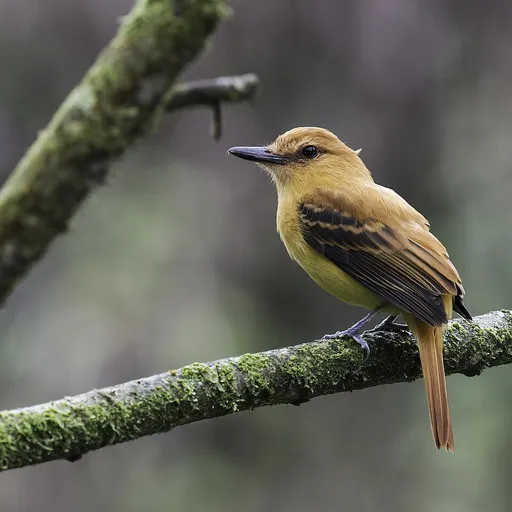
Ochraceous Attila
Attila torridus
Near Threatened
Listen
XC249615 · Niels Krabbe · Manabí: Río Ayampe, Ecuador · CC BY-SA 4.0
Overview
The ochraceous attila (Attila torridus) is a Near Threatened species of tyrant flycatcher found in South America. It is a monotypic species that was previously misclassified in other families before being recognised within Tyrannidae.
Identification
- Measures 20 to 22 cm in length and weighs approximately 46 g, with identical plumage in both sexes.
- Features cinnamon-ochraceous upperparts with a yellowish rump, and underparts that are yellowish ochraceous, being yellowest on the belly.
- Displays two prominent ochraceous wing bars formed by the edges of dusky wing coverts, contrasting with blackish primaries.
- Possesses a reddish brown iris, a dusky bill, and gray legs and feet.
- Song consists of a rising series of whistled notes described as 'wuuu-wuuu-weee-weee-weeé-weeé-wuyeép!', while its most common call is a strikingly hawk-eagle-like 'whooeer'.
Habitat
Inhabits the interior and edges of semi-humid to humid forests, secondary growth, and nearby clearings or plantations. Found from extreme southwestern Colombia through western Ecuador and into northwestern Peru, generally at lower elevations although it occurs higher in the southern province of Loja.
Diet
Feeds primarily on arthropods and fruit, foraging singly or in pairs by gleaning from vegetation in the forest's mid-story to the canopy. It typically takes prey after a short sally from a perch.
Did you know?
Its most common call is strikingly hawk-eagle-like, often extending into a complex sequence of 'whooeer, wheréu, whit-whit'. The species is considered somewhat tolerant of disturbance, as it can be found in patchy forest fragments, although its population is believed to be decreasing due to habitat loss.
Sources
- Wikipedia · CC BY-SA 4.0
- Wikidata · CC0 1.0