
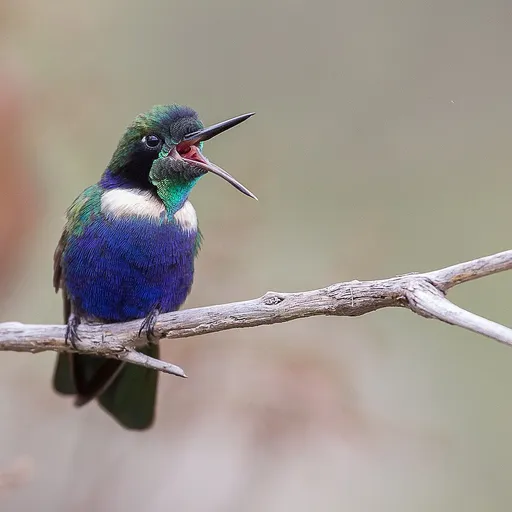
Hyacinth Visorbearer
Augastes scutatus
Least Concern
Overview
The hyacinth visorbearer (Augastes scutatus) is a species of hummingbird in the family Trochilidae, endemic to Brazil. It is currently classified as Least Concern by the IUCN, with a stable population despite its restricted range.
Identification
- Males are 8.1 to 9.9 cm long with a shiny golden-green forehead and throat edged in black, a deep blue belly, and a creamy white to pink chest band.
- Females are slightly smaller, 8 to 9.7 cm, with a green throat lacking a black edge, a blue belly mottled with gray and blue-green, and outer tail feathers tipped with gray.
- Both sexes possess a short bill, though the male's is longer, and both have purplish-blue 'ruffs' on the sides of the neck.
- The song, sung only by males, is described as a series of high, dry 'tjic', 'whi', and 'zuzu' notes.
Habitat
Found exclusively in the Brazilian state of Minas Gerais, the bird typically inhabits dry rocky areas with low vegetation known as campos rupestres. Specific subspecies may also occupy gallery forests, bushy areas, and ravines in montane forest at elevations ranging from approximately 900 to 2,000 m.
Diet
The hyacinth visorbearer forages 2 to 3 m above ground, taking nectar from a wide variety of flowering plants including terrestrial bromeliads and cacti. It also captures small insects by flying out from a perch or by gleaning while perched, with males defending feeding territories rich in flowers.
Did you know?
The nest is constructed from Compositae seeds and cactus 'wool', with leaf and moss fragments attached to the outer surface using spider web. Incubation is performed solely by the female, lasting 15 to 16 days for a clutch of two white eggs.
Sources
- Wikipedia · CC BY-SA 4.0
- Wikidata · CC0 1.0