
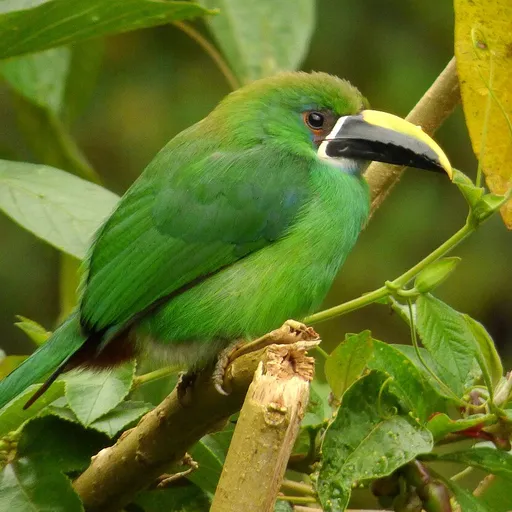
White-throated Toucanet
Aulacorhynchus albivitta
Least Concern
Overview
The southern emerald toucanet, also known as the white-throated toucanet (Aulacorhynchus albivitta), is a near-passerine bird in the toucan family Ramphastidae. It is currently classified as a species of Least Concern by the IUCN, although its population is believed to be decreasing despite its large range.
Identification
- Adults measure 33 to 38 cm in length and weigh between 160 and 230 g.
- Plumage is primarily green, appearing lighter below than above, with the nominate subspecies featuring a white throat.
- The bill is black with a wide yellow stripe along the culmen and a white vertical strip at the base, with some subspecies showing chestnut or maroon near the culmen.
- A bare yellow to orange ring surrounds the dark eye, which is further encircled by blue feathers, while the legs and feet are olive green with dusky yellow soles.
- Vocalisations vary by region, described as rapid short 'took' or 'churt' notes in Colombia and a guttural 'grá-val' in Venezuela.
Habitat
This species inhabits montane regions of Colombia, Ecuador, western Venezuela, Peru, and northern Bolivia. It primarily resides in the interior of humid montane forest but also utilises forest edges, secondary forests, plantations, and clearings with scattered trees.
Diet
The bird forages by gleaning in the middle to upper levels of the forest, usually while perched. Its eclectic diet consists of a wide variety of fruits, terrestrial invertebrates, and small vertebrate prey.
Did you know?
Little is known about the breeding biology of this species, though it nests in tree cavities with a seasonal timeline that shifts from January to September in Colombia and Venezuela to September to November in Ecuador.
Sources
- Wikipedia · CC BY-SA 4.0
- Wikidata · CC0 1.0