
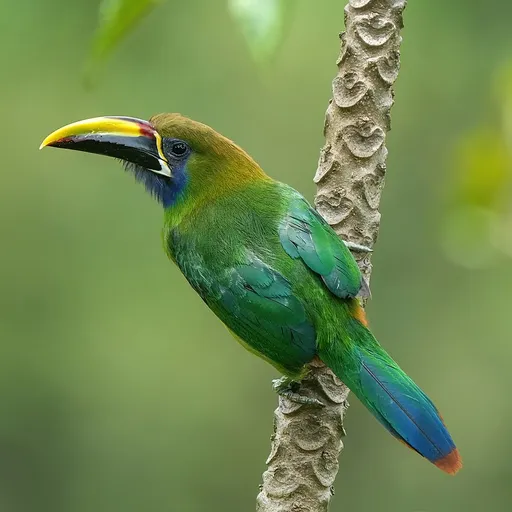
Emerald Toucanet
Aulacorhynchus prasinus
Least Concern
Overview
The northern emerald toucanet, also known as Wagler's toucanet, is a brightly marked species in the toucan family Ramphastidae. It is a gregarious bird that inhabits montane regions from southern Mexico to southern Panama.
Identification
- Adults are 29 to 37 cm long with plumage that is mainly green, appearing lighter below than above, and featuring bright yellow-green flanks and chestnut undertail coverts.
- The large bill has a black mandible, a yellow maxilla with a black patch near the nares, and a white vertical strip at its base.
- The call consists of a nasal, barking 'Wok!-Wok!-Wok!' series, often accompanied by a growling, throaty 'wra'a'a'a'a'a'a'ak'.
Habitat
Primarily found in humid montane forests, though it also occupies secondary forests, shrublands, pastures, and plantations. Its elevation range spans from near sea level up to at least 3,000 m. The species is non-migratory across its range in southern Mexico to southern Panama.
Diet
This bird forages by gleaning, usually while perched. Its eclectic diet includes a wide variety of fruits, invertebrates of many orders, and vertebrate prey such as birds, eggs, lizards, and snakes.
Did you know?
The specific epithet prasinus is derived from the Ancient Greek word prason, meaning 'leek', referencing the bird's distinctive leek-green plumage.
Sources
- Wikipedia · CC BY-SA 4.0
- Wikidata · CC0 1.0