
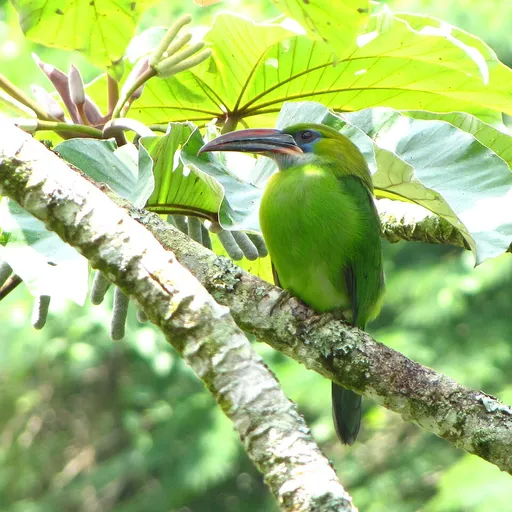
Groove-billed Toucanet
Aulacorhynchus sulcatus
Least Concern
Overview
The groove-billed toucanet (Aulacorhynchus sulcatus) is a near-passerine bird in the toucan family Ramphastidae. It is found in the mountainous regions of Colombia and Venezuela. The species is currently assessed as Least Concern by the IUCN, although its population is believed to be decreasing.
Identification
- Measures 33 to 37 cm in length and weighs between 130 and 200 g.
- Possesses a distinctive grooved culmen and mandible, with bills that are wine-red to brown-red in the nominate and A. s. erythrognathus subspecies, and mostly yellow in A. s. calorhynchus.
- Plumage is predominantly green, with lighter underparts, yellowish undertail coverts, and a white throat in the nominate subspecies.
- Song consists of barking-growling notes or croaks transcribed as "wik-wik- to waak-waak-", often sung in duet.
Habitat
Primarily inhabits humid montane forest but also occurs in secondary forest, forest edges, nearby isolated trees, and gardens. It generally avoids large open areas and ranges in elevation from near sea level up to approximately 2,400 m, though most commonly found between 900 and 2,000 m.
Diet
The species is omnivorous, consuming fruit, invertebrates, eggs, and small vertebrates. It forages at all levels of its habitat, sometimes in groups, and has been observed following army ant swarms.
Did you know?
The subspecies A. s. erythrognathus is considered for separate species status specifically because its voice is distinct from that of the other subspecies, apparently sounding faster.
Sources
- Wikipedia · CC BY-SA 4.0
- Wikidata · CC0 1.0