
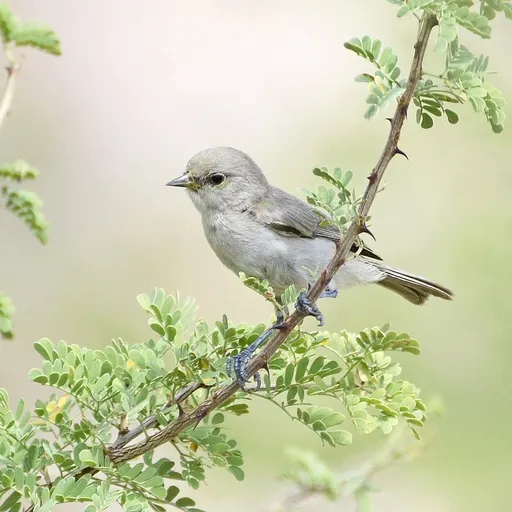
Verdin
Auriparus flaviceps
Least Concern
Overview
The verdin, scientifically known as Auriparus flaviceps, is a very small passerine and the sole representative of the Old World family Remizidae in North America. Classified as a penduline tit, it holds the distinction of being the only species within the genus Auriparus.
Identification
- Size: Approximately 11 cm (4.5 in) in length, rivaling the American bushtit as one of the smallest passerines in North America.
- Plumage: Adults feature a grey body with a bright yellow head and a distinctive rufous shoulder patch; juveniles lack the rufous patch and yellow head.
- Bill: Uniquely shaped with a thick base near the head that tapers to a sharply pointed tip.
- Vocalisations: Produces loud, rapid staccato calls such as 'tschep' or 'chip-chip-chip' while foraging, and 'tseet' calls to maintain contact within breeding pairs.
Habitat
Verdins are residents of the Sonoran and Chihuahuan Deserts, ranging from southern California, Nevada, Utah, New Mexico, and Oklahoma southward through Mexico. They favour shrub-land, scrubby outcrops, and thorny thickets with few trees, where they construct spherical nests from bulky twigs lined with soft materials.
Diet
Primarily insectivorous, verdins continuously forage in desert trees and scrubs for tiny adult and larval insects. They also consume both hard and soft mast from various trees and shrubs, and are occasionally known to visit hummingbird feeders for sugar water.
Did you know?
Despite being monogamous during the breeding season, verdins do not maintain pairs throughout the year, instead behaving as solitary birds for the rest of their lives. Both males and females actively build nests for roosting and breeding, with males sometimes constructing extra 'display nests' to potentially demonstrate partner suitability, although this correlation remains unconfirmed.
Sources
- Wikipedia · CC BY-SA 4.0
- Wikidata · CC0 1.0