
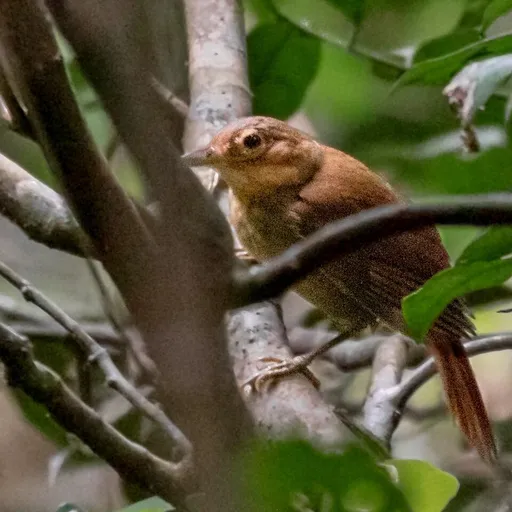
Ochre-throated Foliage-gleaner
Automolus ochrolaemus
Least Concern
Listen
XC248886 · Niels Krabbe · Los Ríos: 'Río Palenque Science Center', Ecuador · CC BY-SA 4.0
Overview
The ochre-throated foliage-gleaner (Automolus ochrolaemus) is a species of bird in the ovenbird family Furnariidae, found across much of mainland South America and in Panama. It is currently classified as a species of Least Concern by the IUCN, though its population is believed to be decreasing.
Identification
- Length of 18 to 20 cm with a shortish, heavy bill.
- Adults feature a mostly dark brownish face with a bold buff eyering, a malar area that is ochraceous-buff with faint dark flecks, and a deep buff throat.
- Plumage includes dark brown crown and nape with faint scalloping, rich dark brown back blending to dark chestnut uppertail coverts, and a breast streaked with medium brown and ochraceous buff.
- Song is a series of well-separated, descending notes, such as 'keh-keh-keh-kreh' or 'kee-kee-ke-krr', often sung at dawn and dusk.
Habitat
This species inhabits a variety of forested landscapes, including lowland rainforest, transitional forest, seasonally flooded várzea forest, swamp forest, and secondary forest. Its range covers Panama and most mainland South American countries, excluding Argentina, Chile, Paraguay, and Uruguay, typically at elevations between sea level and 1,500 m.
Diet
It feeds mostly on insects, spiders, and small vertebrates like frogs. Foraging is done singly, in pairs, or in mixed-species flocks, usually from the undergrowth to the mid-storey by acrobatically gleaning and pulling prey from epiphytes, debris, and dead leaves, though it has also been observed flipping leaf litter on the ground in Central America.
Did you know?
The only documented information regarding its breeding biology comes from a single observation in 1929, which described a nest as a shallow but bulky cup of leaf stems built inside a chamber at the end of a tunnel excavated in an earthen stream bank.
Sources
- Wikipedia · CC BY-SA 4.0
- Wikidata · CC0 1.0