
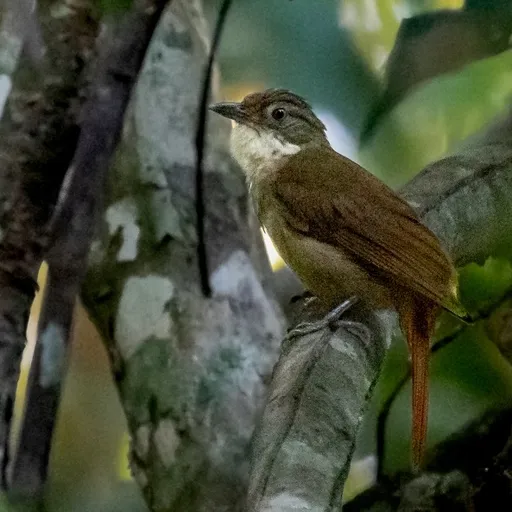
Para Foliage-gleaner
Automolus paraensis
Least Concern
Overview
The Para foliage-gleaner (Automolus paraensis) is a species of bird in the ovenbird family Furnariidae, endemic to Brazil. It was formerly considered a subspecies of the olive-backed foliage-gleaner but was elevated to full species status in 2002 based on vocal differences.
Identification
- Size: 18 to 19 cm long, weighing 32 to 41 g; a fairly large member of its genus with a heavy bill.
- Plumage: Blackish brown face with reddish streaks on the ear coverts; rich dark olivaceous-brown back blending to dark reddish brown uppertail coverts; white throat and breast sides with a gray wash on the center breast; dark rufous tail.
- Bill and Legs: Maxilla is black to dark olive-horn and mandible is olive horn to gray or pale brown; legs and feet are grayish green to yellowish olive.
- Song: Very high, penetrating, sharp 'kreet-kreetkrititit' slightly descending; call is a nasal 'wheet wheet'.
Habitat
Found in tropical evergreen forest, primarily terra firme but also várzea and secondary forest, ranging from near sea level to 700 m elevation. Its distribution is restricted to Brazil south of the Amazon, stretching from the right bank of the Rio Madeira east to the Atlantic in Maranhão state and south to Rondônia and Mato Grosso states.
Diet
Feeds on a variety of larval and adult insects and spiders, as well as small lizards. It forages singly, in pairs, or as part of a mixed-species feeding flock, mostly within the forest undergrowth. It acrobatically gleans and pulls prey from epiphytes, debris, bark crevices, and especially from clumps of dead leaves.
Did you know?
The species was only recognised as distinct in 2002 following the publication of significant vocal differences that led to its elevation from subspecies status. Its breeding season is poorly defined but includes at least January and February, during which it excavates tunnels in earthen banks to build cup nests of plant fibres.
Sources
- Wikipedia · CC BY-SA 4.0
- Wikidata · CC0 1.0